
Book Appointment Now

AMD FX-8350 vs Ryzen 5 2600X
AMD FX-8350 vs Ryzen 5 2600X: Full CPU Comparison & Upgrade Guide (2025)
⚡ Quick Summary
The AMD FX-8350 (2012, Piledriver, 32nm) and the Ryzen 5 2600X (2018, Zen+, 12nm) represent two very different eras of AMD processor design. While the FX-8350 was AMD’s flagship eight-core chip in its day, the Ryzen 5 2600X outperforms it in virtually every real-world scenario — delivering around 134% higher aggregate benchmark performance, better power efficiency, and a more future-proof platform. If you’re considering an upgrade from the FX-8350 to the Ryzen 5 2600X, this guide covers everything you need to know.
Introduction: Two Generations, One Big Gap
When AMD launched the FX-8350 in October 2012, it was the company’s answer to Intel’s Sandy Bridge lineup. Clocked at 4.0 GHz base with a 4.2 GHz boost, it was marketed as an eight-core powerhouse. In reality, the Piledriver architecture had a fundamental flaw — each “module” shared key execution resources between two cores, meaning the real-world performance per core was far weaker than the spec sheet implied.
Fast forward to 2018, and AMD launched the Ryzen 5 2600X on the Zen+ architecture. Built on a cutting-edge 12nm process, it brought true simultaneous multi-threading (SMT), dramatically improved IPC (Instructions Per Clock), and a much lower TDP — all at a competitive price point. The difference between these two CPUs isn’t just a generation gap; it’s a complete architectural overhaul.
Whether you’re a budget gamer sitting on an aging AM3+ system, a content creator wondering if an upgrade is worth it, or simply curious how these two processors stack up, this detailed comparison will give you everything you need to make an informed decision.
Core Specifications: Head-to-Head
| Specification | AMD FX-8350 | Ryzen 5 2600X |
|---|---|---|
| Architecture | Piledriver | Zen+ (Pinnacle Ridge) |
| Manufacturing Process | 32nm (GlobalFoundries) | 12nm (TSMC) |
| Physical Cores | 8 (4 dual-core modules) | 6 (true cores) |
| Threads | 8 | 12 (SMT) |
| Base Clock | 4.0 GHz | 3.6 GHz |
| Boost Clock | 4.2 GHz | 4.2 GHz |
| L3 Cache | 8 MB | 16 MB |
| TDP | 125W | 95W |
| Memory Support | DDR3 (up to 1866 MHz) | DDR4 (up to 2933 MHz official) |
| PCIe Version | PCIe 2.0 | PCIe 3.0 |
| Socket | AM3+ | AM4 |
| Integrated Graphics | None | None |
| Release Year | 2012 | 2018 |
| Cooler Included | Basic AMD cooler | Wraith Spire cooler |
| Overclocking | Unlocked multiplier | Unlocked multiplier |
Architecture Deep Dive: Why IPC Matters More Than Core Count
The FX-8350’s biggest marketing trick was its core count. Eight cores sound impressive, but the Piledriver architecture grouped cores into dual-core “modules” where each pair shared a floating-point unit and fetch/decode resources. This means that under many workloads, the eight cores effectively performed more like four to five fully independent cores. Modern software and games that depend on strong single-core performance were particularly unkind to the FX platform.
The Ryzen 5 2600X, by contrast, uses AMD’s Zen+ architecture — a true generational leap. Each of its six cores is fully independent with dedicated resources, and SMT adds six extra logical threads for a total of twelve. The IPC improvement from Piledriver to Zen+ is roughly 50–60%, meaning even at the same clock speed, the 2600X does dramatically more work per cycle.
The Module Architecture Myth
AMD’s marketing of the FX-8350 as an “8-core” processor was technically accurate but practically misleading. Games and single-threaded applications consistently saw the FX-8350 struggle against Intel’s dual- and quad-core offerings that had far superior IPC. The Ryzen 5 2600X put AMD back on equal footing with Intel in single-core performance and surpassed it in multi-threaded tasks in many scenarios.
Performance Benchmarks: Real-World Numbers
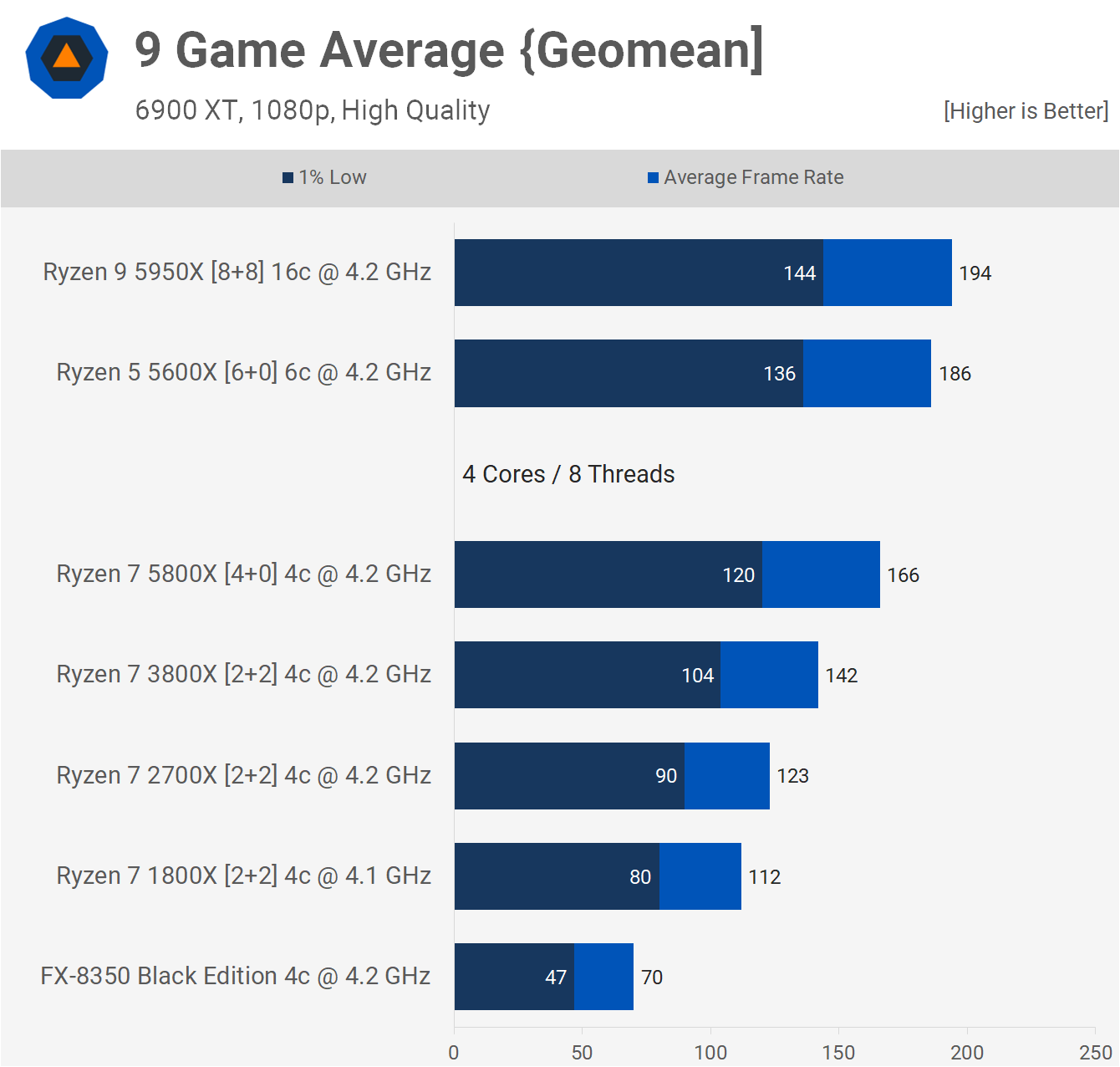
Benchmark data from PassMark PerformanceTest (combining over 26,000 submissions) paints a clear picture. The Ryzen 5 2600X is significantly faster in both single-threaded and multi-threaded tests. Aggregated benchmark scores across multiple platforms show the 2600X delivering around 134% higher performance than the FX-8350 overall.
| Benchmark | AMD FX-8350 | Ryzen 5 2600X | Winner |
|---|---|---|---|
| PassMark CPU Mark (Multi-Thread) | ~7,400 | ~14,600 | ✅ 2600X (+97%) |
| PassMark Single-Thread | ~1,520 | ~2,280 | ✅ 2600X (+50%) |
| Cinebench R20 (Multi-Core) | ~1,750 | ~3,200 | ✅ 2600X (+83%) |
| Cinebench R20 (Single-Core) | ~235 | ~390 | ✅ 2600X (+66%) |
| Gaming (1080p, CPU-bound) | Notable bottleneck | Capable for 1080p/1440p | ✅ 2600X |
| Blender Render | Significantly slower | ~2× faster | ✅ 2600X |
| Power Consumption (TDP) | 125W | 95W | ✅ 2600X (−24%) |
💡 Pro Tip
The FX-8350 uses ~27% more power than the Ryzen 5 2600X while delivering significantly less performance. Over a year of typical use, this translates to a meaningful difference in your electricity bill — especially relevant if you run your PC for long hours daily.
⚡ Performance: Where the Gap Really Shows
The Ryzen 5 2600X completely outclasses the FX‑8350 in every metric. Here’s how they compare across real‑world benchmarks.
Single‑Core Performance (Higher is better)
| Benchmark | FX‑8350 | Ryzen 5 2600X | Difference |
|---|---|---|---|
| Cinebench R15 (single) | 96‑97 cb | 163‑176 cb | Ryzen ~80% faster |
| Cinebench R20 (single) | 205‑209 cb | 421 cb | Ryzen ~103% faster |
| Geekbench 6 single | 576 | 1,287 | Ryzen ~123% faster |
| CPU‑Z single | 241 | 446 | Ryzen ~85% faster |
Real‑world meaning: The Ryzen feels snappier in everyday tasks, web browsing, and especially gaming—where single‑core speed is king.
Multi‑Core Performance (Higher is better)
| Benchmark | FX‑8350 | Ryzen 5 2600X | Difference |
|---|---|---|---|
| Cinebench R15 multi | 636‑665 cb | 1,341‑1,380 cb | Ryzen ~110% faster |
| Cinebench R20 multi | 1,298‑1,325 cb | 2,688‑3,048 cb | Ryzen ~115% faster |
| Cinebench R23 multi | 3,803 pts | 7,514 pts | Ryzen ~98% faster |
| Geekbench 6 multi | 2,361 | 5,598 | Ryzen ~137% faster |
| 7‑Zip (MIPS) | 22,151 | 33,222 | Ryzen ~50% faster |
| Blender 2.81 (bmw27) | 691.3 sec | 278.4 sec | Ryzen ~148% faster |
| wPrime 1024m | 246 sec | 133.8 sec | Ryzen ~84% faster |
Gaming Performance: The FX-8350’s Achilles Heel
Gaming is arguably where the gap between these two CPUs is most painful for FX-8350 owners. Modern games from 2019 onward were developed with true multi-core processors in mind, and many games specifically benefit from strong single-core performance. The FX-8350’s weak IPC means it hits a ceiling quickly in CPU-bound scenarios.
Common gaming pain points on the FX-8350 include:
- Frame rate stuttering in open-world games (GTA V, Cyberpunk 2077, The Witcher 3)
- CPU bottlenecking mid-to-high tier GPUs like the GTX 1070 and above
- Poor performance in games using DirectX 12 and Vulkan multi-threading
- High minimum frame times (1% and 0.1% lows), causing perceived choppiness
The Ryzen 5 2600X, on the other hand, handles 1080p and 1440p gaming comfortably with a modern GPU. While it’s not a powerhouse by 2025 standards, it won’t bottleneck mainstream GPUs like the RTX 3060 or RX 6600 XT in most titles.
Is the FX-8350 Good Enough for Gaming in 2025?
Bluntly: no, not for modern titles. You’ll experience significant CPU bottlenecks, frame drops, and stuttering in games released after 2019. The FX-8350 was borderline for gaming even in 2018 — it’s now firmly below the threshold for a smooth gaming experience in demanding modern titles.
Pros & Cons: AMD FX-8350
Pros & Cons: Ryzen 5 2600X
Platform & Upgrade Path: AM3+ vs AM4
One of the most decisive factors in this comparison is the platform. The AM3+ socket is a dead end — AMD abandoned it after the FX series, and no new CPUs will ever be released for it. If you’re on AM3+, you’re stuck unless you change your motherboard, RAM, and CPU together.
AM4, which the Ryzen 5 2600X uses, is significantly more versatile. Many AM4 motherboards (particularly X470 and B450 boards) support BIOS updates to run Ryzen 5000 series CPUs — giving you a meaningful upgrade path. This alone makes the Ryzen 5 2600X platform a far smarter long-term investment.
| Platform Factor | AM3+ (FX-8350) | AM4 (Ryzen 5 2600X) |
|---|---|---|
| Socket Longevity | Dead — no new CPUs | Active until 2022 (AMD promise) |
| Upgrade Path | None | Ryzen 3000 / 5000 on many boards |
| Memory Type | DDR3 | DDR4 |
| PCIe Version | PCIe 2.0 | PCIe 3.0 |
| Budget Board Options | Very cheap (AM3+ boards) | B450 boards widely available |
⚠️ Warning
If you’re planning to upgrade from AM3+ to AM4, remember you’ll need to budget for a new motherboard AND new DDR4 RAM in addition to the CPU. Factor this into your total cost — the CPU price alone doesn’t tell the full story.
Content Creation & Productivity Workloads
For video editing, 3D rendering, software compilation, and other heavily threaded productivity tasks, the Ryzen 5 2600X is the clear winner. Its 12 threads and superior IPC deliver roughly twice the rendering throughput of the FX-8350 in applications like Blender, Handbrake, and Adobe Premiere.
The FX-8350 was once a popular choice for budget video editors because of its eight cores, but its weak floating-point performance (shared per module) made it slower than expected in creative applications. The 2600X resolves this completely with dedicated FP resources per core.
Streaming Performance
Neither CPU is ideal for simultaneous game streaming in 2025. However, the Ryzen 5 2600X handles software encoding (x264) far better than the FX-8350, giving smoother streams at equivalent quality settings. For best results with either CPU, using hardware encoding (AMD VCE / NVIDIA NVENC) via your GPU is recommended.
Should You Upgrade from FX-8350 to Ryzen 5 2600X?
If you’re currently on an FX-8350 and considering a move to the Ryzen 5 2600X, the performance gain is absolutely real and meaningful — especially for gaming and productivity. However, consider these points before pulling the trigger:
✅ Upgrade Checklist
- ☐ Budget includes a new AM4 motherboard (B450 or X470 recommended)
- ☐ Budget includes DDR4 RAM (16GB / 2x8GB recommended)
- ☐ GPU is capable enough to take advantage of the CPU upgrade (GTX 1060 or better)
- ☐ You game in modern titles released after 2018
- ☐ You do video editing, 3D rendering, or other CPU-intensive creative work
- ☐ You’re bothered by high electricity usage from the 125W FX-8350
- ☐ You want an upgrade path to Ryzen 5000 later without another platform change
Consider Ryzen 5000 Instead
If budget allows, it’s worth skipping the 2600X entirely and aiming for a Ryzen 5 5600 or Ryzen 5 5600X. These Zen 3 chips offer another significant IPC jump over the 2600X, and they run on the same AM4 platform. Given that the 2600X is now several years old itself, a Ryzen 5000 chip represents better long-term value if you’re making a full platform switch anyway.
Power Consumption & Thermals
The FX-8350 runs hot and hungry. With a 125W TDP and the Piledriver architecture’s inefficient design, real-world power draw under load can exceed 150W. You’ll need a quality aftermarket cooler to keep temperatures under control — the stock cooler is barely adequate.
The Ryzen 5 2600X’s 95W TDP, combined with TSMC’s efficient 12nm process, results in much lower real-world heat output. It ships with AMD’s Wraith Spire cooler, which handles the chip comfortably in most non-overclocked scenarios. If you plan to overclock, an aftermarket cooler is still recommended but the baseline thermal situation is far more manageable.
| Thermal Metric | AMD FX-8350 | Ryzen 5 2600X |
|---|---|---|
| TDP (Official) | 125W | 95W |
| Max Operating Temp | 61°C | 95°C (Tdie) |
| Stock Cooler Quality | Barely adequate | Good (Wraith Spire) |
| Power Efficiency | Low | High |
Final Verdict: Which CPU Wins?
🏆 Our Verdict
The Ryzen 5 2600X wins decisively in every performance category that matters in 2025. It delivers approximately 134% higher aggregate performance, significantly better single-core and gaming performance, lower power consumption, and a meaningful upgrade path via AM4. The FX-8350 had its moment in 2012–2015, but it’s now simply too old and architecturally limited for modern workloads.
If you’re an FX-8350 user planning an upgrade, the Ryzen 5 2600X is a solid generational step forward. If budget allows, consider going straight to a Ryzen 5 5600 or better for an even more future-proof build.
Recommended Products
🛒 Ryzen 5 2600X
AMD Ryzen 5 2600X Processor with Wraith Spire Cooler — 6 cores, 12 threads, 3.6GHz base / 4.2GHz boost.
🛒 B450 Motherboard (AM4 Platform)
A quality B450 motherboard is recommended for pairing with the Ryzen 5 2600X — supports DDR4 and potential Ryzen 5000 upgrade via BIOS.
🛒 DDR4 16GB RAM Kit
Pair your Ryzen 5 2600X with fast DDR4-3200 memory for maximum performance. 16GB (2x8GB) is the sweet spot in 2025.
Frequently Asked Questions (FAQ)
Q1: Is the AMD FX-8350 still good for gaming in 2025?
No. The FX-8350 struggles significantly in modern games released after 2019. Its weak single-core IPC causes CPU bottlenecks, frame stuttering, and poor minimum frame rates. It was borderline acceptable in 2017–2018 but is now clearly below the threshold for a smooth modern gaming experience.
Q2: How much faster is the Ryzen 5 2600X than the FX-8350?
In aggregate benchmark testing across multiple platforms, the Ryzen 5 2600X is approximately 134% faster overall. In single-threaded performance specifically, it leads by roughly 50–60% due to its superior Zen+ IPC. In gaming, the real-world difference is significant and very noticeable.
Q3: Do I need a new motherboard to use the Ryzen 5 2600X if I have an FX-8350?
Yes, absolutely. The FX-8350 uses the AM3+ socket while the Ryzen 5 2600X uses AM4. These are completely incompatible sockets. You’ll need a new AM4 motherboard and DDR4 RAM in addition to the CPU itself.
Q4: Should I buy the Ryzen 5 2600X or go for a newer Ryzen in 2025?
If you’re making a full platform switch from AM3+, consider spending a bit more to get a Ryzen 5 5600 or Ryzen 5 5600X. These Zen 3 chips offer another major leap in IPC and gaming performance over the 2600X, and they use the same AM4 platform. The 2600X is becoming dated and may need replacing sooner.
Q5: Is the FX-8350 worth anything in 2025?
For budget users who need a basic workstation for light tasks, web browsing, or legacy software, the FX-8350 on a cheap AM3+ board can still serve a purpose. For gaming or creative work, however, it’s simply too slow and power-hungry to be worth investing in.
📚 Related Articles
📣 Ready to Upgrade?
If this guide helped you make a decision, check out our other CPU comparison guides and budget PC build recommendations. Whether you’re moving from the AM3+ platform or building fresh, we’ve got you covered.

Jaeden Higgins is a tech review writer associated with DigitalUpbeat. He contributes content focused on PC hardware, laptops, graphics cards, and related tech topics, helping readers understand products through clear, practical reviews and buying advice.


