
Book Appointment Now


Best PSU Brands
Best PSU Brands 2026: The Ultimate Power Supply Buying Guide
Your graphics card gets the spotlight. Your CPU gets the benchmarks. But the unsung hero of every stable, high-performance PC? The power supply unit (PSU). It’s the component that takes raw electricity from your wall and transforms it into the clean, stable power that your expensive components need to function—and it does this thousands of times per second. A poor-quality PSU doesn’t just risk random shutdowns; it can literally destroy your graphics card, motherboard, and storage drives in a single catastrophic failure .
In 2026, the landscape of power supplies has evolved dramatically. With the adoption of the ATX 3.1 standard and the new 12V-2×6 connector for next-gen GPUs, choosing the right PSU brand and model is more critical than ever. The global market for modular PSUs is projected to grow at a CAGR of 9.5% from 2026 to 2032 , reflecting the increasing demand for high-efficiency, flexible power solutions. But with so many brands—Corsair, Seasonic, EVGA, MSI, and more—how do you choose?
This guide cuts through the marketing noise. We’ve analyzed the top PSU manufacturers, their 2026 product lines, and what makes each brand unique. Whether you’re building a budget gaming rig, a silent home office PC, or an extreme overclocking workstation, we’ll help you find the perfect power supply for your needs.
Pro Tip: Never skimp on your power supply. A common rule of thumb among PC builders is to allocate 10-15% of your total build budget to the PSU. This investment protects your CPU, GPU, and motherboard—components that can easily cost three times as much as the power supply itself.
If you are searching for the best PSU brands for a gaming PC, the most reliable power supply brand, or a PSU tier list that shows which models are actually worth buying, this guide covers all three. We compare the top power supply brands on the things that matter most — build quality, efficiency rating, warranty, noise, and ATX 3.1 / 12V-2×6 support — and then show you how to pick the right wattage for your GPU, from an RTX 5070 build to an RTX 5090 workstation.
The 2026 PSU Market: What’s Changed?
Before diving into specific brands, it’s crucial to understand the technological shifts defining the 2026 PSU market. The biggest change is the widespread adoption of the ATX 3.1 specification and the 12V-2×6 power connector. This new standard, an evolution of the ATX 3.0 and the original 12VHPWR connector, is designed to handle the massive power spikes (or “transient spikes”) that modern graphics cards like the NVIDIA GeForce RTX 50-series can demand. ATX 3.1-certified PSUs must handle power excursions up to 200% of their rated wattage for brief milliseconds, ensuring your system doesn’t crash under sudden load .
Additionally, efficiency ratings continue to improve. While 80 Plus Gold has become the baseline for most quality builds, Platinum and Titanium units are increasingly accessible, offering lower electricity bills and less heat output. The global AC-DC power supply unit market itself is substantial, valued at US$ 8.57 billion in 2025 and projected to reach US$ 14.09 billion by 2032 . This growth is fueled not just by gaming, but by AI workstations, content creation rigs, and the ever-increasing power demands of high-end components.
ATX 3.0 vs ATX 3.1: Do You Need to Upgrade Your Power Supply?
ATX 3.1 is a refinement of ATX 3.0, and the headline change for gamers is the updated 12V-2×6 connector (also written 12V-2×6) used by modern high-end graphics cards. If you are buying a new PSU for an RTX 50-series build, choose a unit that natively supports ATX 3.1 and the 12V-2×6 cable so you don’t need an adapter. If you already own a good ATX 3.0 power supply, check the manufacturer’s compatibility notes before replacing it — a quality unit with the correct native GPU cable is often fine, but an adapter is the less clean option.
Top PSU Brands of 2026: In-Depth Analysis
The PSU market is unique because many brands don’t actually manufacture their own units. They design them and then contract with original equipment manufacturers (OEMs) like Seasonic, Super Flower, Channel Well Technology (CWT), or Flextronics to build them. Understanding these relationships can help you gauge the quality and reliability of a PSU beyond just the brand name on the box.
1. Seasonic: The Gold Standard of Reliability
Best For: Enthusiasts, professionals, and anyone who prioritizes build quality, longevity, and silent operation above all else.
Seasonic holds a unique position in the market as both a premier OEM for other brands and a top-tier direct-to-consumer manufacturer . When you buy a Seasonic PSU, you’re buying from the source—the company that actually designs and builds the internal components. This vertical integration translates into legendary reliability and some of the longest warranties in the industry.
For 2026, the Seasonic PRIME TX series remains the undisputed king of consumer PSUs. These units boast an 80 Plus Titanium efficiency rating, meaning they can achieve up to 94% efficiency under typical loads, drastically reducing wasted energy and heat . The PRIME TX series is built with the highest-quality Japanese capacitors, a hybrid fan control system for near-silent operation, and comes with a staggering 12-year warranty . For most high-end builds, the PRIME TX-1300 or TX-1600 offers virtually unmatched stability and future-proofing .
For mainstream builders, the Seasonic Focus series is the go-to recommendation. These Gold and Platinum-rated units deliver the core Seasonic values—excellent voltage regulation, quiet operation, and fully modular cabling—at a more accessible price point, making them a staple for reliable mid-range gaming rigs .
Warning: While Seasonic is renowned for quality, be aware that some of their older, non-ATX 3.0/3.1 models may require adapter cables for newer RTX 40-series and 50-series graphics cards. Always check that the unit you’re buying includes native 12V-2×6 support for a clean and safe installation.
2. Corsair: The Comprehensive Ecosystem
Best For: Gamers and PC builders who want a broad range of options, from budget-friendly to extreme performance, all backed by excellent software and support.
Corsair is arguably the most recognizable name in PC components, and their PSU lineup reflects their commitment to offering a product for every market segment. They partner with top-tier OEMs like CWT and Flextronics to produce units that consistently rank among the best in professional reviews .
In 2026, the Corsair RMx series (RM750x, RM850x, RM1000x) continues to be the benchmark for high-quality Gold-rated power supplies. These fully modular units are praised for their silent operation, excellent build quality, and a 10-year warranty. They are the perfect choice for almost any single-GPU gaming system . For those building with flagship components like an Intel Core i9-15900K and an RTX 5090, the Corsair HX series (Platinum-rated) and the flagship AX series (Titanium-rated) offer the enhanced efficiency and premium components needed for absolute stability under extreme loads .
Corsair’s ecosystem integration is a significant advantage. Their iCUE software can monitor the PSU’s power draw, efficiency, and fan speed, providing a level of system insight that is particularly appealing for enthusiasts who enjoy detailed telemetry. Their customer support and community forums are also widely recognized for being responsive and helpful .
Pro Tip: The Corsair RMx Shift series is a 2026 standout for builders who prioritize cable management. These PSUs relocate the modular interface to the side of the unit, making it significantly easier to route cables in tight cases and behind the motherboard tray.
3. EVGA: The Gamer’s Choice for Value and Support
Best For: Gamers seeking high performance, competitive pricing, and some of the best customer service in the industry.
EVGA built its reputation in the graphics card market and successfully translated that success to power supplies. Their focus is squarely on the gaming community, offering a wide array of SuperNOVA series units that deliver excellent performance per dollar . They partner with top OEMs like Super Flower (known for their exceptional designs) and Seasonic to bring competitive products to market.
The EVGA SuperNOVA G7 series (Gold-rated) is a popular choice for mainstream gaming builds, offering fully modular design, quiet fans, and a 10-year warranty at a price that often undercuts competitors . For enthusiasts, the SuperNOVA P6 series (Platinum) and the SuperNOVA T2 series (Titanium) provide the higher efficiency and tighter voltage regulation that overclockers and high-performance system builders demand .
What truly sets EVGA apart is their customer service. They have a well-earned reputation for easy RMA (Return Merchandise Authorization) processes and responsive support staff who understand the needs of PC enthusiasts. This peace of mind is invaluable, especially for first-time builders who might have questions or concerns .
4. be quiet!: The Silent Operation Specialist
Best For: Home theater PCs (HTPCs), recording studios, quiet office builds, and any user for whom noise level is the primary concern.
As their name suggests, be quiet! has carved a niche by engineering power supplies that prioritize acoustic performance without compromising on electrical performance. Their German-engineered units are renowned for using high-quality, noise-dampening materials and sophisticated fan controllers that keep fans off until absolutely necessary .
The be quiet! Dark Power Pro series is the company’s flagship, offering Titanium efficiency and near-inaudible operation even under heavy loads. These units feature an oversized, silent-optimized fan and a “Overclocking Key” that allows you to switch between multi-rail and single-rail +12V operation, a feature valued by extreme overclockers . For a more balanced price-to-performance ratio, the Straight Power series delivers Gold and Platinum efficiency with the same commitment to quiet operation, making it an excellent choice for high-end gaming PCs where silence is golden .
Warning: be quiet! PSUs are generally excellent, but their case designs can sometimes be restrictive. If you’re building in a small form factor (SFF) case, double-check the PSU dimensions, as some models are slightly longer than standard ATX units.
5. MSI & ASUS: The Motherboard Giants Enter the PSU Arena
Best For: Builders who want cohesive aesthetics with their MSI or ASUS motherboard and graphics card, and who appreciate feature-rich designs.
Both MSI and ASUS have significantly expanded their PSU offerings in recent years, leveraging their massive ecosystem to offer compelling products. They often partner with reputable OEMs like CWT to produce units that meet their high brand standards.
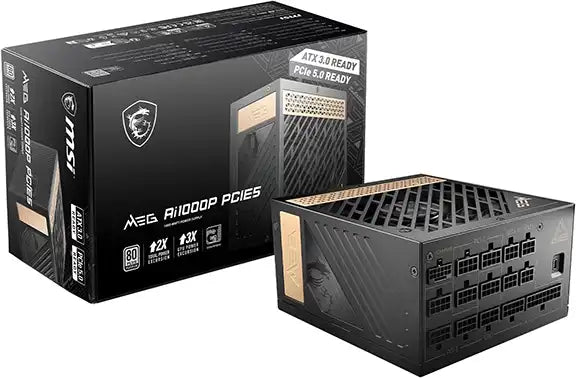
MSI’s Meg Ai1300P / Ai1000P series (Platinum-rated) are standout options for high-end builds. They feature native ATX 3.0/3.1 support, a sleek design, and a useful OLED display that shows real-time power draw in watts—a neat feature for enthusiasts who like to monitor their system’s energy consumption . They also offer the MPG A-GF series, a more mainstream Gold-rated line that provides excellent value.
ASUS’s ROG Thor series (Platinum and Titanium) is designed to compete with the best in the market. They feature high-quality components, a signature OLED power display, and Aura Sync RGB lighting for perfect integration with other ASUS ROG components. The ROG Thor series is often praised for its excellent build quality and voltage regulation, making them a top-tier choice for those building all-ROG systems .
6. Thermaltake: The Innovator in Aesthetics
Best For: Builders who want to showcase their system and value unique features like integrated RGB lighting and specialized form factors.
Thermaltake takes a design-first approach to power supplies, often integrating features that other brands overlook. Their Toughpower series includes a range of Gold, Platinum, and even Titanium-rated units that span the performance spectrum. What makes them stand out is their willingness to incorporate RGB lighting into their PSUs, allowing builders to synchronize the power supply with their case fans and other components for a unified look .
Thermaltake also offers unique form factors, such as the Toughpower SFX series, which is designed for compact builds. They are often at the forefront of new connector standards, ensuring their units are ready for the latest hardware. While performance is solid across their product lines, the focus is clearly on delivering a visually stunning product for showcase builds .
7. Other Notable Brands: Cooler Master, Lian Li, & FSP
Several other brands deserve mention for their contributions to the 2026 PSU market. Cooler Master continues to offer reliable units like the V-series (Gold and Platinum), which are well-regarded for their performance. Lian Li has gained attention with its unique Edge series, which features a rotating AC input for easier cable management and even includes an integrated USB hub—a testament to their innovative case-centric design philosophy .
FSP (Fortron Source) is a major OEM manufacturer that also sells its own PSUs. They offer excellent value for budget-conscious builders, particularly with their Dagger SFX and Hydro series. For users in Asia and Europe, brands like SilverStone, Antec, and Gigabyte also maintain a strong presence with competitive offerings .
Seasonic vs Corsair: Which Power Supply Brand Should You Buy?
Both are safe choices, so the decision usually comes down to priorities. Seasonic is the pick if you want the longest warranties, an OEM-level reputation, and a quiet, no-nonsense power supply built to last — the PRIME TX line is the flagship example. Corsair is the pick if you want the widest range of wattages and price points, easy availability, and software monitoring through iCUE — the RMx series is the mainstream favorite. For most gaming PCs, a quality Gold-rated unit from either brand with the right wattage and native 12V-2×6 support will serve you well.
Which PSU Brands Are Actually Reliable? Brand vs Model Matters
A brand name alone does not guarantee quality. The same brand can sell excellent Gold-rated units and weaker budget models, and many brands use different OEM platforms across their lineup. Seasonic, Corsair, be quiet!, and Fractal Design are frequently cited as consistently reliable PSU brands, but it is smart to cross-check the specific model against independent reviews and a community-maintained PSU tier list that ranks units by internal build quality. Avoid unbranded or uncertified units, and make sure any power supply you buy carries a proper 80 Plus certification and a solid warranty.
2026 PSU Tier List: From Entry-Level to Enthusiast
To simplify your choice, we’ve categorized the best PSUs of 2026 into performance tiers based on efficiency, build quality, and features. This structure is derived from industry-standard tier lists and expert reviews .
Tier A: High-End / Enthusiast (Premium Builds & Overclocking)
These are the best power supplies money can buy. They feature Titanium or Platinum efficiency, top-tier Japanese capacitors, fully modular designs, and robust warranties. Perfect for systems with flagship CPUs and GPUs.
- Seasonic PRIME TX (1300W/1600W): Titanium efficiency, 12-year warranty, exceptional voltage regulation .
- Corsair AX1600i: Titanium-rated, digital monitoring via Corsair Link, unparalleled performance.
- be quiet! Dark Power Pro 13 (1300W): Titanium efficiency, near-silent operation, multi-rail switching .
- MSI Meg Ai1300P: Platinum efficiency, ATX 3.0/3.1 ready, OLED power display .
- EVGA SuperNOVA T2 (1600W): Titanium-rated, 10-year warranty, a favorite among extreme overclockers .
- ASUS ROG Thor Platinum II (1200W): Platinum efficiency, OLED display, Aura Sync RGB .
Tier B: Mid-Range / Performance (High-Performance Gaming)
The sweet spot for most gamers. These Gold-rated units offer excellent reliability, fully modular designs, and strong performance for high-end single-GPU systems.
- Corsair RMx Series (750W-1000W): Gold efficiency, quiet operation, 10-year warranty, a perennial favorite .
- Seasonic Focus Plus Gold (750W-1000W): Gold efficiency, compact design, excellent performance for the price .
- EVGA SuperNOVA G7 (750W-1000W): Gold efficiency, fully modular, backed by EVGA’s excellent support .
- MSI MPG A1000G: Gold efficiency, ATX 3.0/3.1 ready, a great value option for RTX 50-series builds .
- be quiet! Straight Power 12 (850W): Platinum/Gold efficiency, exceptionally quiet, ideal for silent-focused builds .
Tier C: Budget / Entry-Level (Mainstream & Office PCs)
These units are suitable for budget gaming rigs, home office computers, or builds with lower-power components. They typically feature Bronze efficiency and may be semi-modular or non-modular.
- Corsair CX-M Series (650W): Bronze efficiency, semi-modular, a reliable budget choice .
- EVGA BR/BQ Series (600W-700W): Bronze efficiency, solid performance for budget systems .
- Thermaltake Smart BM2 (650W): Bronze efficiency, semi-modular, good for basic gaming PCs.
- Cooler Master MWE Bronze (650W): Bronze efficiency, non-modular, a dependable no-frills option.
Key Considerations When Choosing a PSU Brand
1. Form Factor: ATX vs. SFX
The vast majority of PC cases use the standard ATX form factor. However, if you’re building a compact Small Form Factor (SFF) PC, you’ll likely need an SFX or SFX-L power supply. Brands like Corsair (SF series), Seasonic (Focus SGX), and Cooler Master (V SFX series) offer excellent SFX options. Always check your case’s specifications before purchasing .
2. Warranty and Support
Warranty length is a reliable indicator of a manufacturer’s confidence in their product. Seasonic and Corsair offer up to 12 and 10 years on their high-end units, respectively. EVGA is renowned for its customer support experience. When choosing a brand, it’s worth researching the RMA process and warranty terms specific to your region .
3. Modularity
Fully modular PSUs (all cables detachable) are the gold standard, simplifying cable management and reducing clutter. Semi-modular units (essential cables attached, others detachable) are a good budget compromise. Non-modular units (all cables fixed) are increasingly rare in quality builds due to the cable management challenges they present .
4. Using a PSU Calculator
Before making a purchase, use an online PSU calculator to estimate the wattage your system needs. It’s wise to add a 20-30% headroom to account for power spikes and future upgrades. A system with an RTX 5080 and a high-end CPU might be fine with 850W, but an RTX 5090 with an Intel Core i9 could comfortably require 1000W or more .
Pro Tip: For 2026 builds, prioritize ATX 3.1 and PCIe 5.1 (12V-2×6) support. This ensures your PSU is natively compatible with the latest graphics cards without needing potentially problematic adapter cables. Many brands now clearly label these units for easy identification.
How Many Watts Do You Need? PSU Wattage Guide for Gaming PCs
Choosing the right wattage is just as important as choosing the right brand. A good rule of thumb is to add 20–30% headroom above your system’s estimated peak power draw, which keeps the power supply in its efficient range and leaves room for future upgrades. In practice, a quality 650W–750W Gold unit covers most mid-range gaming PCs, 850W suits many high-end builds, and flagship cards like the RTX 5090 are better paired with 1000W or more.
- Entry-level and esports builds: 550W–650W is usually enough with a modest GPU and a mainstream CPU.
- Mid-range gaming (RTX 5060 / RTX 5070 class): 650W–750W of Gold-rated power is a common recommendation.
- High-end gaming (RTX 5080 class): 850W gives comfortable headroom.
- Flagship and workstation builds (RTX 5090 class): 1000W or more is the safer choice.
Always check the graphics card manufacturer’s recommended PSU wattage for your exact model, since figures vary by card and by CPU, and use a PSU calculator to confirm.
80 Plus Bronze vs Gold vs Platinum vs Titanium: Which Efficiency Rating Is Worth It?
For most new gaming builds, 80 Plus Gold is the practical sweet spot — it delivers around 90% efficiency at 50% load without the price premium of higher tiers. Bronze is acceptable for budget and office PCs, though it wastes more energy as heat. Platinum and Titanium cost more but reduce heat and electricity use, which matters most for systems that run for long hours or sit under heavy load. A higher efficiency rating does not automatically mean better build quality, so pair the rating with independent reviews and a solid warranty.
Key Takeaways
- Seasonic is the benchmark for reliability and build quality, making it the best choice for workstations and enthusiasts .
- Corsair offers the most comprehensive range of options, with the RMx series being an excellent mainstream choice and the AX series a top-tier flagship .
- EVGA excels in value and customer support, making them a gamer favorite for high-performance builds at competitive prices .
- be quiet! is the undisputed leader in silent operation, perfect for noise-sensitive environments .
- MSI and ASUS are strong contenders, especially for builders creating ecosystem-focused systems with their other components .
- Thermaltake brings innovation in aesthetics, with RGB and unique form factors for showcase builds .
- Always verify ATX 3.1 / PCIe 5.1 compatibility for new builds, use a PSU calculator to determine wattage, and prioritize fully modular units for ease of building.
Frequently Asked Questions (FAQ)
Which PSU brand is the most reliable?
Seasonic is widely considered the most reliable consumer PSU brand due to their role as an OEM manufacturer and their use of premium components. Their PRIME series, in particular, is known for exceptional build quality and a 12-year warranty . Corsair and EVGA also have excellent reputations for reliability, especially in their high-tier product lines like the RMx and SuperNOVA series .
Is 850W enough for an RTX 5090 build?
While an 850W PSU is sufficient for many systems, it is the minimum recommended wattage for an RTX 5090. To provide adequate headroom for transient power spikes and potential future upgrades, a 1000W or even 1200W PSU from a reputable brand is a safer, more future-proof choice .
What is the difference between 80 Plus Gold, Platinum, and Titanium?
These are efficiency ratings. Gold-rated PSUs are at least 87% efficient at 100% load, Platinum are at least 89%, and Titanium are at least 90% at 100% load and up to 94% at 50% load. Higher efficiency means less wasted electricity, less heat, and often quieter operation due to less fan use .
Do I need an ATX 3.1 PSU for the RTX 50-series graphics cards?
It is highly recommended. ATX 3.1 PSUs come with the native 12V-2×6 connector, eliminating the need for adapters. They are also certified to handle the high transient power spikes that modern GPUs can draw, ensuring system stability. While an older PSU with a proper adapter can work, a native ATX 3.1 unit is the cleanest and most reliable solution .
Can I use a higher wattage PSU than I need?
Yes, absolutely. A PSU only draws the power that the system demands. Using a 1200W unit in a system that only needs 600W is perfectly safe. In fact, it can be beneficial because the PSU will operate at a lower percentage of its maximum load, often leading to quieter operation, higher efficiency, and longer component life .
What is the best PSU brand for a gaming PC?
Seasonic and Corsair are the safest all-round choices for a gaming PC, with be quiet! a strong pick if low noise matters and EVGA, MSI, and ASUS worth considering depending on price and availability. Rather than choosing on brand alone, shortlist a specific Gold-rated, fully modular model with the right wattage, native 12V-2×6 support, and a long warranty.
How many watts do I need for a gaming PC in 2026?
Most mid-range gaming PCs run well on a quality 650W–750W power supply, high-end RTX 5080-class builds are comfortable at around 850W, and RTX 5090-class systems are safer with 1000W or more. Add 20–30% headroom over your estimated peak draw and confirm the figure with a PSU calculator and your graphics card’s recommended specification.
Is 80 Plus Bronze good enough in 2026?
For budget builds and office PCs, a reputable Bronze-rated PSU is acceptable. For most new gaming PCs, 80 Plus Gold is the better baseline because it wastes less power as heat and is often paired with better components and longer warranties.
Is a fully modular PSU worth it?
Usually yes. Fully modular power supplies make cable management easier and improve airflow, especially in compact or glass-panel cases. Semi-modular units are a sensible budget compromise, while non-modular units are best kept to low-cost builds.
Seasonic or Corsair: which PSU brand is better?
Both are excellent. Seasonic is best known for premium build quality and long warranties, while Corsair offers a broader range of models, widely available options, and iCUE monitoring. Compare the specific models, wattage, and warranty rather than choosing on brand alone.
Summary
Choosing the best PSU brand in 2026 is about balancing performance, budget, and your specific needs. For those seeking the absolute pinnacle of reliability and build quality, Seasonic’s PRIME series remains the gold standard. If you want a broad range of excellent options backed by a strong ecosystem, Corsair is your best bet. For gamers who value competitive pricing and top-tier customer support, EVGA delivers in spades. Meanwhile, be quiet! is the only choice for truly silent builds, and ASUS and MSI offer compelling options for ecosystem-focused enthusiasts.
Remember, the power supply is the foundation of your entire PC. It’s not the place to cut corners. By selecting a quality unit from one of these top brands, ensuring it meets the ATX 3.1 standard, and calculating your wattage needs with a proper headroom, you’ll build a system that’s stable, efficient, and ready for the demands of modern gaming and computing for years to come. Invest wisely, and your components will thank you with long, stable, and powerful performance.

Jaeden Higgins is a tech review writer associated with DigitalUpbeat. He contributes content focused on PC hardware, laptops, graphics cards, and related tech topics, helping readers understand products through clear, practical reviews and buying advice.


