
Book Appointment Now


7 Best Small Form Factor Graphics Cards
7 Best Small Form Factor Graphics Cards for Gaming in 2026
Quick Summary: Small form factor (SFF) builds are booming — but finding a GPU compact enough for a mini-ITX or SFF case while still delivering real gaming performance is harder than it looks. This guide ranks the 7 best small form factor graphics cards for gaming in 2026 — covering every budget from ~$180 to ~$450, with real specs, honest pros and cons, performance targets, and direct Amazon links for every card.
Building a capable gaming PC in a mini-ITX case or compact SFF chassis is one of the most rewarding — and unforgiving — challenges in PC building. Every millimetre counts. GPU length restrictions in compact cases can range from 170mm to 250mm, and many standard-size gaming GPUs that would fit a mid-tower simply do not clear the obstruction points of a 7-litre or 10-litre case. Choose the wrong card and you are facing a rebuild.
The good news is that 2025–2026 has been the best era for SFF GPU options in history. NVIDIA’s Blackwell-based RTX 50 series, AMD’s RDNA 4-powered RX 9000 series, and Intel’s Arc Battlemage lineup have all produced compact variants specifically engineered for tight builds. The 2026 lineup includes single-fan cards under 165mm, dual-fan cards under 210mm, and genuine low-profile (LP/half-height) options with modern architecture — a combination that was unimaginable just three years ago.
Each card in this guide was evaluated against criteria that matter specifically for SFF builders: physical dimensions, power draw and PSU compatibility with SFX units, thermal performance in constrained airflow, real-world 1080p/1440p gaming performance, and compatibility with popular ITX cases like the Fractal Terra, NCASE M1, Dan A4, Lian Li Q58, and Cooler Master NR200.
⚡ Our 7 Top SFF GPU Picks at a Glance
- 🥇 #1 Best Overall SFF: ZOTAC RTX 5060 Ti Twin Edge OC — 220mm, 1440p capable, ~$430
- 🥈 #2 Best Compact 1440p: Gigabyte RTX 5060 Ti Windforce OC — 208mm, excellent thermals, ~$420
- 🥉 #3 Best AMD SFF: ASUS Dual RX 9060 XT OC — 232mm, 16GB VRAM, FSR 4, ~$370
- ⚡ #4 Best Tiny Footprint: ZOTAC RTX 5060 Solo — 165mm single-fan, ultra-compact, ~$320
- 💚 #5 Best Budget Intel: Sparkle Arc B570 Guardian OC — 242mm, 10GB, $180
- 🔵 #6 Best Low-Profile: ZOTAC RTX 5060 Low Profile — half-height, ~$290
- 💰 #7 Best Sub-$250 Value: MSI RTX 4060 Aero ITX — 177mm, proven 1080p, ~$230
Full Comparison: All 7 SFF GPUs Side by Side
| GPU | Length | Fans | VRAM | TDP | Min PSU | Target Res. | Price |
|---|---|---|---|---|---|---|---|
| ZOTAC RTX 5060 Ti Twin Edge OC | 220.5mm | 2x | 16GB GDDR7 | 165W | 600W | 1440p | ~$430 |
| Gigabyte RTX 5060 Ti Windforce OC | 208mm | 2x | 16GB GDDR7 | 165W | 600W | 1440p | ~$420 |
| ASUS Dual RX 9060 XT OC | ~230mm | 2x | 16GB GDDR6 | 150W | 550W | 1440p | ~$370 |
| ZOTAC RTX 5060 Solo | 164.5mm | 1x | 8GB GDDR7 | 145W | 550W | 1080p | ~$320 |
| Sparkle Arc B570 Guardian OC | 242mm | 2x | 10GB GDDR6 | 150W | 500W | 1080p/1440p | ~$180 |
| ZOTAC RTX 5060 Low Profile | ~168mm | 1x | 8GB GDDR7 | 115W | 450W | 1080p | ~$290 |
| MSI RTX 4060 Aero ITX | 177mm | 1x | 8GB GDDR6 | 115W | 550W | 1080p | ~$230 |
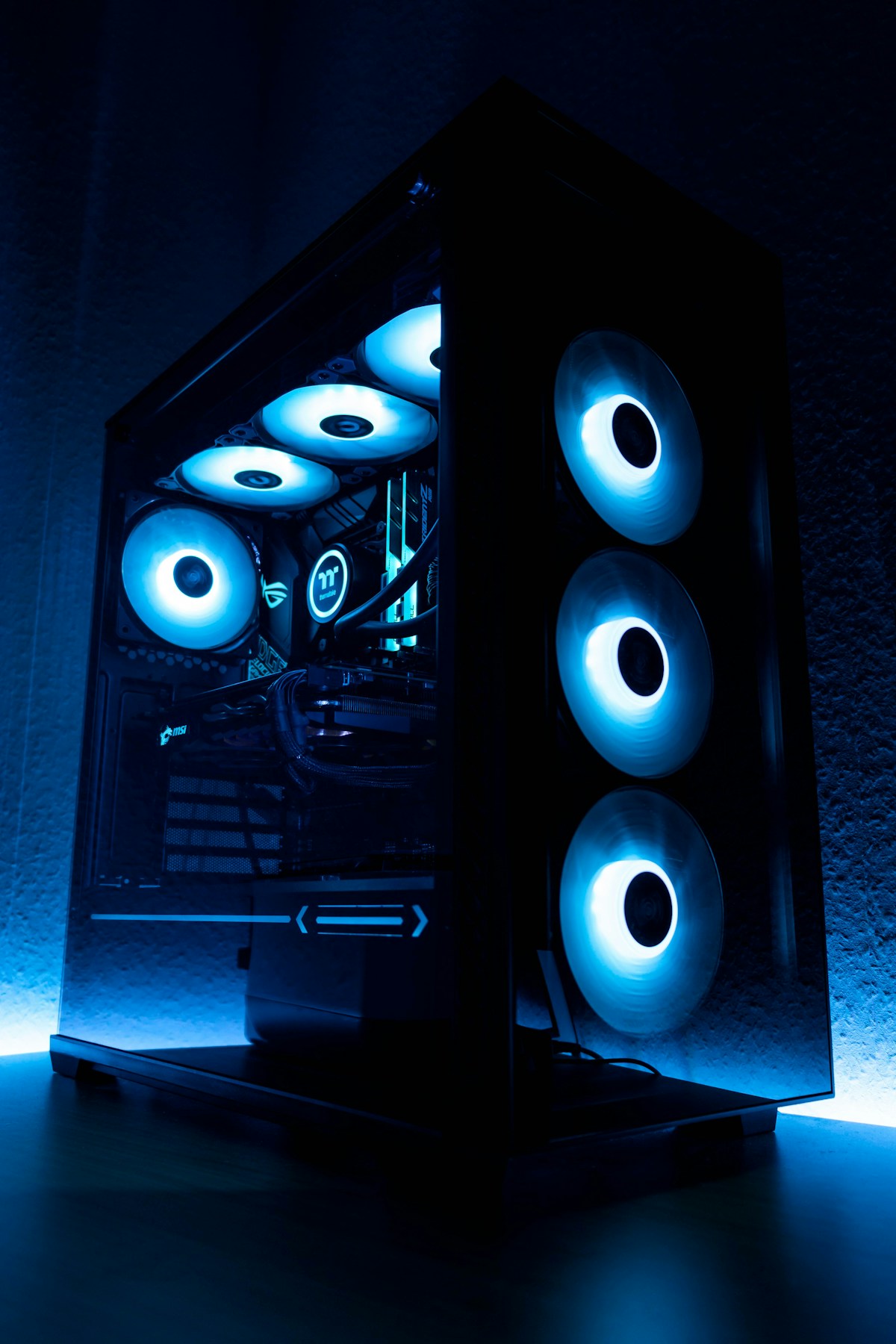
What to Look for in an SFF Graphics Card
Physical Length is the primary constraint. Most mini-ITX cases support GPUs between 170mm and 260mm. Measure your case’s stated GPU clearance before buying — do not assume. Popular cases like the Fractal Terra support up to 322mm, while the Dan A4 caps at around 222mm and the Lian Li Q58 at about 322mm depending on configuration.
Two-slot vs Three-slot Thickness matters in very compact cases. Many SFF cases physically cannot accommodate a triple-slot GPU regardless of length. The cards on this list are all dual-slot or single-slot designs specifically for this reason.
TDP and SFX PSU Compatibility is critical. SFX power supplies (the compact form required by most ITX cases) typically cap at 650W–750W, with 550W being common in builds under 8 litres. All cards on this list are compatible with 550–600W SFX units at stock settings.
Single-fan vs Dual-fan Cooling — single-fan cards run hotter and louder under sustained gaming loads in confined cases. In sub-8L builds with limited airflow, dual-fan cards consistently produce better acoustic and thermal results. Single-fan designs are best when the case specifically benefits from their smaller footprint.
Power Connector Type — all cards on this list use a standard 8-pin PCIe connector. The controversial 16-pin (12VHPWR) connector common on higher-end RTX 50 series cards creates cable management challenges in tight SFF builds. This was a deliberate selection criterion.
🥇 #1 — Best Overall SFF Gaming GPU
ZOTAC GAMING GeForce RTX 5060 Ti Twin Edge OC – 1440p Target

Guide by DigitalUpbeat.com
ZOTAC has been the SFF community’s most consistent GPU ally for years, and the RTX 5060 Ti Twin Edge OC is the clearest expression of that commitment. At just 220.5mm long with a two-slot, dual-fan design and a 165W TDP, it fits comfortably in the vast majority of mini-ITX cases — including notoriously restrictive designs like the Dan A4-SFX (222mm GPU clearance) with just 1.5mm to spare.
Performance-wise, the RTX 5060 Ti is 10–20% faster than the RTX 4060 Ti at 1080p and 1440p, and its 16GB GDDR7 VRAM (on the OC 16GB version) addresses the memory capacity complaints that plagued the previous generation. Digital Trends’ reviewer tested the Twin Edge in an ITX case and noted it stayed under 70°C during extended gaming sessions — impressive thermal discipline for a dual-fan card in a constrained chassis. With DLSS 4 Multi Frame Generation and Blackwell architecture CUDA cores, it handles current and upcoming titles at 1440p with meaningful headroom. The single 8-pin power connector keeps cable management clean — a genuinely underrated advantage inside a tight SFF build.
Full Specifications
| Specification | Detail |
|---|---|
| GPU Architecture | NVIDIA Blackwell (GB206) |
| CUDA Cores | 4,608 |
| VRAM | 16GB GDDR7 (128-bit bus) |
| Memory Bandwidth | 448 GB/s |
| Boost Clock | ~2,577 MHz (OC) |
| TDP / TBP | 165W |
| Power Connector | 1x 8-pin PCIe |
| Min. PSU Recommended | 600W (SFX compatible) |
| Dimensions | 220.5 x 111.2 x 41.6mm — Dual Slot |
| Display Outputs | 2x DisplayPort 2.1b, 1x HDMI 2.1b |
| AI Upscaling | DLSS 4 with Multi Frame Generation |
| Approx. Price | ~$430 |
✅ Pros
- 220.5mm length fits the vast majority of ITX cases including the Dan A4
- 16GB GDDR7 VRAM — generous for future-proofing at 1440p
- DLSS 4 Multi Frame Generation — massive framerate multiplier in supported titles
- Single 8-pin power connector — clean cable management in SFF builds
- Under 70°C in gaming inside an ITX case — excellent thermals
- ZOTAC’s long SFF track record — known reliable partner for compact builds
- Metal backplate for rigidity — prevents GPU sag in vertical-mount builds
❌ Cons
- ~$430 sits at the higher end of this GPU tier
- 8GB model also exists — confirm you’re purchasing the 16GB variant
- 220.5mm leaves only 1.5mm clearance in the Dan A4 — measure twice
- Single fan would be even better for the tightest builds — this is dual-fan
- Limited overclocking headroom due to the compact cooling solution
💡 Buy This If: You want the best overall balance of SFF compatibility, modern performance, and future-proof VRAM for 1440p gaming in any popular mini-ITX case.
🥈 #2 — Shortest Dual-Fan RTX 5060 Ti
Gigabyte GeForce RTX 5060 Ti Windforce OC – 1440p Target

If 220mm still feels tight for your specific case, the Gigabyte RTX 5060 Ti Windforce OC at 208mm is the shortest dual-fan RTX 5060 Ti on the market. That 12mm difference over the ZOTAC Twin Edge matters in builds where GPU clearance is extremely restricted — the NCASE M1 with its 295mm clearance, the Cooler Master NR200 at 330mm, and sub-200mm-capable cases all benefit. PC Guide praised it as a standout ITX option, noting the compact form factor without sacrificing dual-fan cooling discipline.
Gigabyte’s Windforce cooling system on this card uses two 90mm fans in a counter-rotating configuration that reduces turbulence and produces quieter operation than competing single-direction designs. Under gaming loads, it maintains temperatures well within the operating range even inside thermally restricted ITX cases. Performance is essentially identical to the ZOTAC Twin Edge OC at the same base specifications — the 5060 Ti architecture and 16GB GDDR7 are unchanged. The choice between this and the ZOTAC #1 card comes down purely to whether 208mm or 220mm fits your specific case better.
Full Specifications
| Specification | Detail |
|---|---|
| GPU Architecture | NVIDIA Blackwell (GB206) |
| CUDA Cores | 4,608 |
| VRAM | 16GB GDDR7 (128-bit bus) |
| Memory Bandwidth | 448 GB/s |
| Boost Clock | ~2,540 MHz (OC) |
| TDP / TBP | 165W |
| Power Connector | 1x 8-pin PCIe |
| Min. PSU Recommended | 600W (SFX compatible) |
| Dimensions | 208 x 120 x 40mm — Dual Slot |
| Display Outputs | 2x DisplayPort 2.1b, 2x HDMI 2.1b |
| AI Upscaling | DLSS 4 with Multi Frame Generation |
| Approx. Price | ~$420 |
✅ Pros
- 208mm — shortest dual-fan RTX 5060 Ti available, widest case compatibility
- Counter-rotating Windforce fans reduce turbulence and noise
- 16GB GDDR7 VRAM at an SFF-friendly length
- Dual HDMI 2.1b outputs — useful for multi-display or TV setups
- Single 8-pin connector for clean SFF cable management
- Gigabyte’s proven Windforce thermal design
❌ Cons
- Slightly lower OC clock vs ZOTAC Twin Edge (negligible real-world difference)
- 120mm card height — check case height clearance for very slim ITX builds
- Gigabyte App Center software is intrusive during driver installation
- ~$420 — premium pricing reflecting current GPU market conditions
💡 Buy This If: Your case has a GPU clearance between 210mm and 220mm, or you need the absolute shortest dual-fan RTX 5060 Ti for a tight mini-ITX build.
🥉 #3 — Best AMD SFF GPU for 2026
ASUS Dual Radeon™ RX 9060 XT 16GB GDDR6 OC Edition – 1440p Target

Guide by DigitalUpbeat.com
The RX 9060 XT brings AMD’s RDNA 4 architecture and 16GB GDDR6 to compact builds at an aggressively competitive price point. Image Guide by digitalupbeat.comAMD launched the Radeon RX 9060 XT in June 2025 at $299 (8GB) and $349 (16GB), directly targeting the RTX 5060 Ti with competitive pricing and, in the 16GB variant, a meaningful VRAM advantage. The ASUS Dual OC edition brings it to a ~230mm dual-fan form factor that fits most popular ITX cases while delivering RDNA 4 architecture, FSR 4 AI upscaling, AMD Fluid Motion Frames, and 16GB GDDR6 memory for compelling 1440p gaming value.
AMD’s internal testing showed the RX 9060 XT 16GB trading blows with or slightly outperforming the RTX 5060 Ti 8GB across a wide range of 1440p titles, with the VRAM advantage becoming more pronounced in memory-intensive scenarios. The 150W TDP is slightly lower than the RTX 5060 Ti’s 165W, making it more compatible with compact 550W SFX power supplies — relevant for builders in the tightest ITX cases where PSU options are limited. No AIB partner has produced a reference RX 9060 XT; ASUS, MSI, Sapphire, and Gigabyte all produce custom dual-fan compact variants suited to ITX builds.
💡 Buy This If: You prefer AMD, want 16GB VRAM at the best possible price, primarily play non-RT or moderately RT-demanding titles, and your case supports 230mm+ GPUs.
Full Specifications
| Specification | Detail |
|---|---|
| GPU Architecture | AMD RDNA 4 (Navi 44) |
| Compute Units | 32 CUs (2,048 Stream Processors) |
| VRAM | 16GB GDDR6 (128-bit bus) |
| Memory Bandwidth | ~384 GB/s |
| Game / Boost Clock | 2,620 MHz / 3,230 MHz |
| TDP / TBP | 150W |
| Power Connector | 1x 8-pin PCIe |
| Min. PSU Recommended | 550W (SFX compatible) |
| Dimensions (ASUS Dual) | ~232 x 112 x 40mm — Dual Slot |
| Display Outputs | 2x DisplayPort 2.1, 2x HDMI 2.1 |
| AI Upscaling | FSR 4 (AI-based) + AMD Fluid Motion Frames |
| Launch Price | $349 (16GB) / $299 (8GB) |
✅ Pros
- 16GB GDDR6 at $349 MSRP — best VRAM-per-dollar in this tier
- 150W TDP — lower than RTX 5060 Ti, wider 550W SFX PSU compatibility
- RDNA 4 architecture with FSR 4 AI upscaling and Fluid Motion Frames
- Strong 1440p gaming performance, especially in non-RT titles
- Multiple compact AIB variants from ASUS, MSI, Sapphire, Gigabyte
- 8-pin PCIe power — clean SFF cable management
- Aggressive pricing directly competitive with RTX 5060 Ti
❌ Cons
- Ray tracing performance lags behind RTX 5060 Ti in heavily RT-dependent titles
- GDDR6 vs GDDR7 — lower raw memory bandwidth than RTX 5060 Ti
- FSR 4 image quality still trails DLSS 4 in head-to-head image quality testing
- No reference design — compact variant dimensions vary by AIB partner
- RDNA 4 driver maturity slightly behind NVIDIA’s well-established ecosystem
- ~230mm length limits compatibility in the most restrictive ITX cases
💡 Buy This If: You prefer AMD, want 16GB VRAM at the best possible price, primarily play non-RT or moderately RT-demanding titles, and your case supports 230mm+ GPUs.
⚡ #4 — Smallest Modern Gaming GPU Available
ZOTAC GAMING GeForce RTX 5060 Solo – 1080p Target
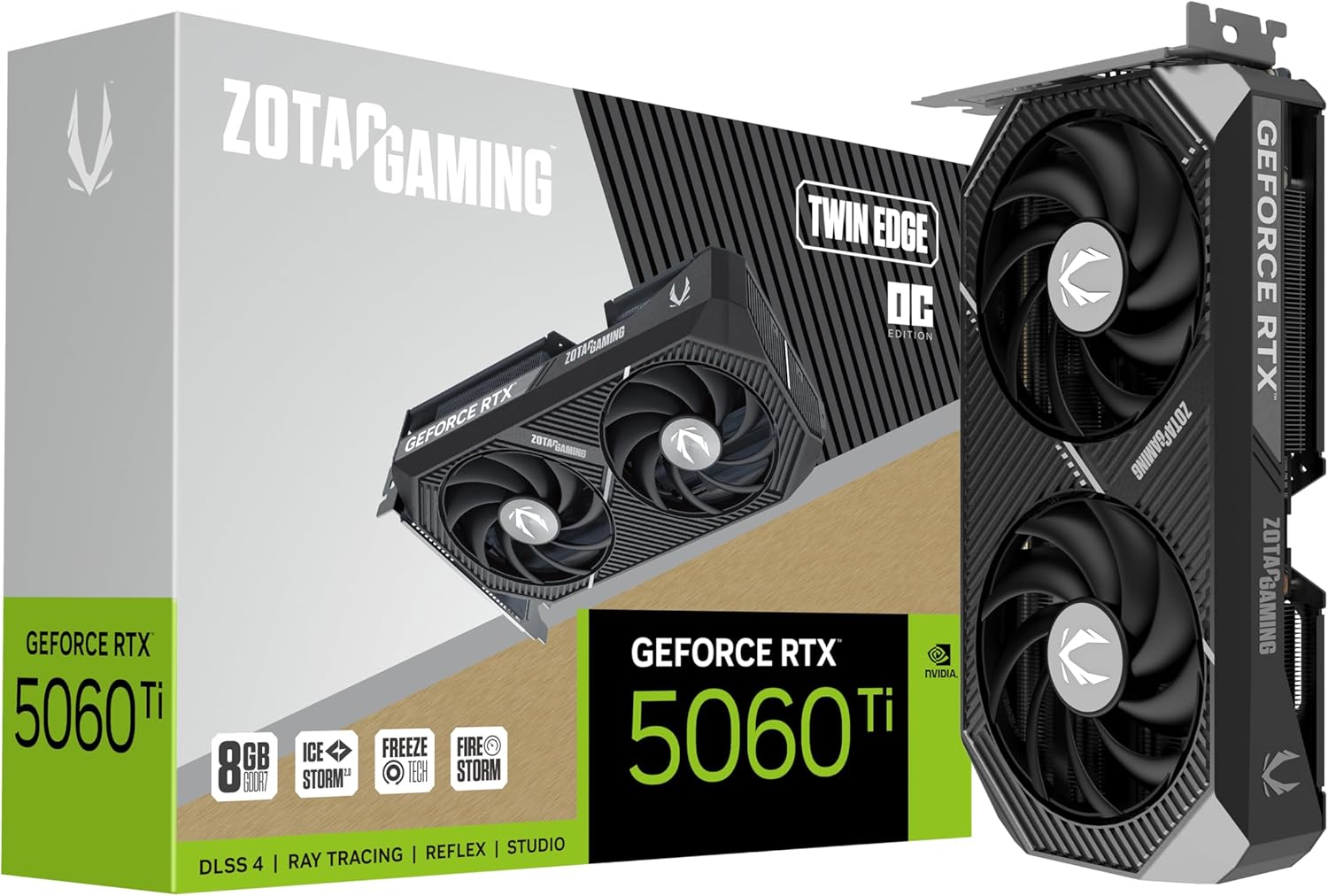
At just 164.5mm × 111.2mm × 36.4mm, the ZOTAC RTX 5060 Solo is one of the smallest discrete gaming GPUs ever made with a modern architecture. It is purpose-designed for sub-10-litre ITX cases, HTPC builds, ultra-compact chassis, and any build where the GPU’s physical footprint is the binding constraint. ZOTAC’s own product page notes it fits in 99% of PC builds — a claim that holds up when you see just how compact this card is.
The 145W TDP runs from a single 8-pin connector and a 550W SFX PSU handles it comfortably. PC Guide reviewed the Solo and noted it as the ideal card when you “want a really small card from the latest generation” — noting its single-fan design stays manageable under gaming loads given the relatively modest power draw of the RTX 5060. With GDDR7 memory and DLSS 4, it delivers smooth 1080p gaming with multi-frame generation headroom for demanding titles. The tradeoff is the 8GB VRAM and single-fan acoustics — under sustained load, the fan audibly ramps up. In builds where the case has good airflow directed across the card, this is manageable. In sealed or low-airflow configurations, expect temperatures in the high 70s°C.
Full Specifications
| Specification | Detail |
|---|---|
| GPU Architecture | NVIDIA Blackwell (GB206) |
| CUDA Cores | 3,840 |
| VRAM | 8GB GDDR7 (128-bit bus) |
| Memory Bandwidth | 448 GB/s |
| Boost Clock | 2,497 MHz |
| TDP / TBP | 145W |
| Power Connector | 1x 8-pin PCIe |
| Min. PSU Recommended | 550W (SFX compatible) |
| Dimensions | 164.5 x 111.2 x 36.4mm — Dual Slot |
| Display Outputs | 2x DisplayPort 2.1b, 1x HDMI 2.1b |
| AI Upscaling | DLSS 4 with Multi Frame Generation |
| Approx. Price | ~$320 |
✅ Pros
- 164.5mm — fits in virtually any case including the most restricted sub-10L builds
- Blackwell architecture with DLSS 4 Multi Frame Generation
- GDDR7 memory — high bandwidth despite 8GB capacity
- 145W TDP compatible with even compact 550W SFX PSUs
- Single 8-pin connector — easiest cable management on this list
- Ideal for HTPC builds, living room gaming PCs, and console-replacement SFF rigs
❌ Cons
- 8GB VRAM is limiting in some modern AAA titles at 1080p ultra settings
- Single fan runs audibly louder under sustained gaming load
- 1080p target only — not a comfortable 1440p performer
- No overclocked variant — runs at reference Blackwell RTX 5060 clocks
- ~$320 feels premium for an 8GB 1080p card in 2026
⚠️ Single-Fan Thermal Warning
The ZOTAC RTX 5060 Solo’s single 95mm fan performs adequately but requires case airflow to stay thermally comfortable. In zero-airflow environments or cases without a dedicated fan near the GPU, temperatures can approach 83–85°C under sustained loads. Plan your case fan configuration accordingly before choosing this card.
The ZOTAC RTX 5060 Solo’s single 95mm fan performs adequately but requires case airflow to stay thermally comfortable. In zero-airflow environments or cases without a dedicated fan near the GPU, temperatures can approach 83–85°C under sustained loads. Plan your case fan configuration accordingly before choosing this card.
💡 Buy This If: Your case has extreme GPU length restrictions — under 170mm — or you need the absolute smallest modern GPU for an HTPC, living room gaming rig, or sub-8L ITX build.
💚 #5 — Best Budget Intel Arc SFF GPU
Sparkle Intel Arc B570 Guardian OC – 1080p / Light 1440p

Intel’s Arc Battlemage series entered the GPU market with a compelling value proposition — outperforming AMD and NVIDIA equivalents in price-per-frame at the sub-$200 tier — and the Sparkle Arc B570 Guardian OC is one of the most genuinely compact implementations of that chip in a dual-fan design. At 242 × 105 × 44mm, it is slightly longer than ideal for the most restrictive cases but fits comfortably in popular ITX enclosures like the Cooler Master NR200, Lian Li Q58, and Fractal Terra.
The B570 features 10GB of GDDR6 VRAM on a 160-bit bus — more memory than either the RTX 5060 8GB or base RX 9060 XT 8GB at a significantly lower price. Intel’s XeSS (Xe Super Sampling) AI upscaling technology has matured considerably with Battlemage and now provides competitive image quality at high performance modes. PC Guide included the Sparkle B570 Guardian in their best ITX GPU list, describing it as a “more set ITX card” with genuine two-fan cooling discipline in a compact footprint. At approximately $180, it undercuts every other card on this list by a significant margin.
Full Specifications
| Specification | Detail |
|---|---|
| GPU Architecture | Intel Battlemage (BMG-G21) |
| Xe Cores | 18 Xe2 Cores (2,304 shaders) |
| VRAM | 10GB GDDR6 (160-bit bus) |
| Memory Bandwidth | ~336 GB/s |
| Boost Clock | ~2,670 MHz (OC) |
| TDP / TBP | 150W |
| Power Connector | 1x 8-pin PCIe |
| Min. PSU Recommended | 500W (SFX compatible) |
| Dimensions | 242 x 105 x 44mm — Dual Slot |
| Display Outputs | 3x DisplayPort 2.1, 1x HDMI 2.1 |
| AI Upscaling | Intel XeSS 2 + XeFG (Frame Generation) |
| Approx. Price | ~$180 |
✅ Pros
- ~$180 — lowest price on this list by a wide margin
- 10GB GDDR6 — more VRAM than RTX 5060 8GB or RX 9060 XT 8GB at this price
- 105mm card height — extremely flat, ideal for the slimmest dual-fan configurations
- 500W minimum PSU — most SFX-friendly power requirement on this list
- 3x DisplayPort 2.1 — excellent multi-monitor support
- XeSS 2 AI upscaling now competitive in quality at performance mode
- Excellent hardware video encode/decode — strong for streaming builds
❌ Cons
- 242mm length — longest on this list, incompatible with the most restrictive cases
- Intel Arc driver maturity still behind AMD and NVIDIA in some older titles
- Inconsistent performance in DX11 and older API games (some titles run poorly)
- Less competitive in ray tracing vs RTX 5060 Ti or RX 9060 XT
- Brand perception — less established in consumer GPU market vs AMD/NVIDIA
- ReBAR (Resizable BAR) is mandatory for best performance — verify BIOS support
💡 Pro Tip: Enable Resizable BAR for Arc B570 Performance
Intel Arc GPUs require Resizable BAR (also called Smart Access Memory on AMD platforms) to achieve their rated performance. Without it, performance can drop 20–30% in some titles. Verify your mini-ITX motherboard supports and has ReBAR enabled in the BIOS before building around the B570. Most modern Z790, B760, AM5, and AM4 boards support it — but double-check before purchasing.
Intel Arc GPUs require Resizable BAR (also called Smart Access Memory on AMD platforms) to achieve their rated performance. Without it, performance can drop 20–30% in some titles. Verify your mini-ITX motherboard supports and has ReBAR enabled in the BIOS before building around the B570. Most modern Z790, B760, AM5, and AM4 boards support it — but double-check before purchasing.
💡 Buy This If: Budget is the top priority, you play primarily modern DX12/Vulkan titles, and your case supports 242mm GPUs. The best bang-per-dollar SFF GPU on this list by a significant margin.
🔵 #6 — Best Low-Profile / Half-Height SFF GPU
ZOTAC GAMING GeForce RTX 5060 Low Profile – 1080p Target
The ZOTAC RTX 5060 Low Profile occupies a completely different category from the rest of this list — it is a true half-height (69mm) low-profile GPU with a bracket for slim desktop cases, SFF OEM enclosures, and any chassis that cannot accept a full-height card. ZOTAC officially describes it as fitting “99% of PC builds” — a claim made possible by its half-height bracket, which lets it work in standard desktop cases, media centre PCs, small workstation cases, and industrial enclosures that no other GPU on this list can enter.
Built on the Blackwell architecture with GDDR7 memory and full DLSS 4 support, it is the most capable low-profile GPU in the 2026 market — a significant leap over the previous generation of LP offerings. At 115W TDP, it operates from a single 8-pin connector and a 450W PSU, making it compatible with the limited power supplies found in SFF OEM systems. The tradeoff is the single-fan design and the constrained cooling surface area that half-height form requires — under sustained full-load gaming, temperatures will run warmer than dual-fan alternatives. For gaming sessions rather than hour-long rendering loads, it manages acceptably.
Full Specifications
| Specification | Detail |
|---|---|
| GPU Architecture | NVIDIA Blackwell (GB206) |
| CUDA Cores | 3,840 |
| VRAM | 8GB GDDR7 (128-bit bus) |
| Memory Bandwidth | 448 GB/s |
| TDP / TBP | 115W |
| Power Connector | 1x 8-pin PCIe |
| Min. PSU Recommended | 450W |
| Card Height | Half-Height (69mm) — Low Profile Bracket Included |
| Approx. Length | ~168mm |
| Display Outputs | 2x DisplayPort 2.1b, 1x HDMI 2.1b |
| AI Upscaling | DLSS 4 with Multi Frame Generation |
| Approx. Price | ~$290 |
✅ Pros
- Half-height form factor — fits slim desktop and OEM SFF cases no other GPU reaches
- Blackwell architecture with DLSS 4 — current generation performance in LP form
- 115W TDP compatible with 450W PSUs in OEM systems
- GDDR7 memory bandwidth — fast despite capacity constraints
- Half-height and full-height brackets included for maximum compatibility
- Ideal GPU upgrade for prebuilt OEM desktops and workstations
❌ Cons
- 8GB VRAM limits headroom in VRAM-hungry modern titles
- Single-fan cooling runs warmer and louder than dual-fan alternatives
- Lower performance ceiling than full-height SFF cards above it on this list
- ~$290 — significant premium over previous-gen LP alternatives for buyers upgrading OEM PCs
💡 Buy This If: You have a slim desktop, OEM tower, or any case that physically cannot fit a standard-height GPU. This is the most capable half-height gaming GPU available today.
💰 #7 — Best Sub-$250 ITX Single-Fan GPU
MSI GeForce RTX 4060 Aero ITX – 1080p Target

Not every compact PC builder needs — or wants to pay for — 2026’s cutting-edge Blackwell GPUs. The MSI GeForce RTX 4060 Aero ITX is the sub-$250 argument that the previous generation still makes excellent sense in SFF builds. At 177mm long with a single-fan design, it is purpose-built for mini-ITX cases with strict length requirements, delivers clean 1080p gaming across virtually all current titles, and pairs with a 550W SFX power supply that most compact builds will already have.
The 115W TDP is low enough that a quality 120mm case fan directing air toward the card keeps thermals acceptable even in restricted enclosures. MSI’s Aero ITX line has a strong reputation in the SFF community for reliable 1080p performance in cases where the Dan A4, NCASE M1, or similar ultra-compact chassis demand a compact GPU that does not compromise on game performance. With DLSS 3 Frame Generation, Ada Lovelace architecture, and the AV1 encoder for content creators who stream, it remains a complete package for 1080p gaming in 2026 at a price the newer generation has not yet reached.
Full Specifications
| Specification | Detail |
|---|---|
| GPU Architecture | NVIDIA Ada Lovelace (AD107) |
| CUDA Cores | 3,072 |
| VRAM | 8GB GDDR6 (128-bit bus) |
| Memory Bandwidth | 272 GB/s |
| Boost Clock | 2,505 MHz |
| TDP / TBP | 115W |
| Power Connector | 1x 8-pin PCIe |
| Min. PSU Recommended | 550W (SFX compatible) |
| Dimensions | 177 x 121 x 41mm — Dual Slot |
| Display Outputs | 3x DisplayPort 1.4a, 1x HDMI 2.1 |
| AI Upscaling | DLSS 3 with Frame Generation |
| Approx. Price | ~$230 |
✅ Pros
- 177mm — fits the Dan A4, NCASE M1, and other ultra-compact ITX cases
- ~$230 — best price-to-1080p-performance ratio on this list
- 115W TDP — very compatible with compact 550W SFX PSUs
- DLSS 3 Frame Generation — meaningful framerate uplift in supported titles
- Ada Lovelace AV1 encoder — excellent for streamers and content creators
- Proven, mature driver ecosystem with excellent game compatibility
- Strong 1080p60 to 1080p144 performance in current games
❌ Cons
- Previous generation — notably less efficient than Blackwell RTX 5060 per watt
- No DLSS 4 Multi Frame Generation (DLSS 3 only)
- 8GB GDDR6 bandwidth (272 GB/s) much lower than GDDR7 alternatives
- Single fan runs audibly under sustained high load in closed cases
- 1080p ceiling only — not recommended for 1440p builds
- Prices for RTX 4060 have risen from MSRP in some markets due to tariff pressure
💡 Buy This If: Budget is a real constraint, your target is 1080p gaming, and you need a short single-fan GPU for an ultra-compact case under $250. Still one of the best compact 1080p cards money can buy.
💡 Pro Tip: Measure Your Case GPU Clearance Before You Buy — Twice
Even a well-documented case like the Dan A4 has multiple configurations with different GPU clearance depending on whether you’re using a vertical GPU mount, a riser cable, or a specific version of the case (v1 vs v2 vs v3 have different clearances). Always check your specific case’s GPU length and height restrictions on the manufacturer’s spec page and cross-reference with the community build log database at SFF.Network for real-world clearance reports before purchasing. GPU specification pages list dimensions as the PCB length — cooler overhang and end-cap brackets can add 2–5mm beyond the stated spec.
Even a well-documented case like the Dan A4 has multiple configurations with different GPU clearance depending on whether you’re using a vertical GPU mount, a riser cable, or a specific version of the case (v1 vs v2 vs v3 have different clearances). Always check your specific case’s GPU length and height restrictions on the manufacturer’s spec page and cross-reference with the community build log database at SFF.Network for real-world clearance reports before purchasing. GPU specification pages list dimensions as the PCB length — cooler overhang and end-cap brackets can add 2–5mm beyond the stated spec.
Which SFF GPU Should You Actually Buy?
🥇 Best all-round SFF card under 225mm for 1440p gaming? → ZOTAC RTX 5060 Ti Twin Edge OC. 220mm, 16GB GDDR7, DLSS 4, fits the Dan A4 by 1.5mm.
🥈 Need the absolute shortest dual-fan RTX 5060 Ti? → Gigabyte RTX 5060 Ti Windforce OC. 208mm — best for cases with 210–220mm restrictions.
🥉 Prefer AMD with maximum VRAM at the best price? → ASUS Dual RX 9060 XT OC. 16GB GDDR6 at ~$370, 150W TDP, competitive 1440p performance.
⚡ Need a GPU under 170mm for extreme builds? → ZOTAC RTX 5060 Solo. 164.5mm, Blackwell architecture, DLSS 4 — the smallest modern gaming GPU.
💚 Tightest budget possible? → Sparkle Arc B570 Guardian OC. ~$180, 10GB VRAM, solid 1080p/light 1440p, excellent for DX12 titles.
🔵 Upgrading an OEM PC or slim desktop that needs half-height? → ZOTAC RTX 5060 Low Profile. Only current-gen LP gaming GPU with GDDR7 and DLSS 4.
💰 Sub-$250, needs to fit an ultra-compact case, 1080p gaming? → MSI RTX 4060 Aero ITX. 177mm, proven 1080p performance, great driver maturity, easy on SFX PSUs.
⚠️ GPU Price Warning: Tariffs and AI Demand Are Affecting Street Prices in 2026
Tom’s Hardware noted in early 2026 that GPU street prices have increased significantly above MSRP due to AI wafer demand crowding out gaming GPU production and import tariff pressure. The RTX 5060 Ti at ~$429–$430 MSRP is currently among the better-priced Blackwell cards relative to its value tier, but street prices can vary by $50–$100 depending on timing and retailer. Use CamelCamelCamel to track Amazon price history before purchasing, and consider waiting for retail promotions if the gap between MSRP and street price is wide at the time of purchase.
Tom’s Hardware noted in early 2026 that GPU street prices have increased significantly above MSRP due to AI wafer demand crowding out gaming GPU production and import tariff pressure. The RTX 5060 Ti at ~$429–$430 MSRP is currently among the better-priced Blackwell cards relative to its value tier, but street prices can vary by $50–$100 depending on timing and retailer. Use CamelCamelCamel to track Amazon price history before purchasing, and consider waiting for retail promotions if the gap between MSRP and street price is wide at the time of purchase.
Key Takeaways
- Always verify GPU length, height, and slot width against your case’s specific GPU clearance spec — manufacturer-stated dimensions sometimes exclude cooler overhang.
- For dual-fan 1440p performance in the widest range of ITX cases, the ZOTAC RTX 5060 Ti Twin Edge OC (220mm) and Gigabyte Windforce OC (208mm) are the top 2026 picks.
- The ZOTAC RTX 5060 Solo at 164.5mm is the answer when case clearance is under 170mm — no other modern gaming GPU matches its footprint.
- The AMD RX 9060 XT 16GB is the best VRAM-per-dollar SFF GPU at $349, but its 230mm length and weaker RT performance are meaningful considerations.
- The Intel Arc B570 (Sparkle Guardian OC) delivers remarkable value at ~$180 for builders who primarily play modern DX12/Vulkan titles and need 10GB VRAM on a budget.
- All cards on this list use a standard 8-pin PCIe power connector — avoiding the cable management headaches of the 16-pin connector in tight SFF builds.
- Single-fan cards run louder and hotter than dual-fan equivalents in constrained cases — plan case fan configurations before committing to a single-fan design.
Final Verdict: Best SFF GPU for Your Build
The 2026 SFF GPU market is better than it has ever been. NVIDIA’s Blackwell architecture, AMD’s RDNA 4, and Intel’s Battlemage have all produced genuinely compact gaming GPUs that deliver real 1080p and 1440p performance without requiring massive cooling solutions or high-wattage PSUs — two constraints that define the SFF building experience.
The ZOTAC RTX 5060 Ti Twin Edge OC is our top overall recommendation: 220mm, 16GB GDDR7, DLSS 4, and proven ITX thermal discipline. For the tightest cases, the ZOTAC RTX 5060 Solo at 164.5mm is in a class by itself. For AMD loyalists and VRAM-focused builders, the RX 9060 XT 16GB at $349 is an honest bargain. And for budget builders who need real 1080p performance without emptying their wallet, the MSI RTX 4060 Aero ITX at $230 remains one of the most sensible SFF GPU purchases available.
🛒 Browse All SFF GPUs on Amazon
🛒 Shop SFX Power Supplies on Amazon
FAQ
What is a small form factor (SFF) graphics card?
An SFF GPU is a graphics card designed with reduced physical dimensions — shorter length, lower height, or fewer slots — to fit in mini-ITX cases, compact gaming builds, HTPCs, and slim desktop enclosures. “SFF GPU” can refer to standard-height short-length cards (170–220mm long for ITX builds), low-profile/half-height cards (69mm tall for slim cases), or single-slot ultra-compact designs. The cards on this list cover all three categories, with a focus on gaming-capable performance rather than workstation or display-only use.
How do I know if a GPU will fit in my mini-ITX case?
Check three dimensions against your case specification: GPU length (the most commonly cited), GPU height (measured from the PCIe bracket, typically 111–120mm for standard height, 69mm for low-profile), and slot width (most gaming GPUs are dual-slot; triple-slot cards rarely fit in strict ITX cases). Your case manufacturer’s product page will list the maximum GPU length supported. Cross-reference with real-world build logs at SFF.Network and PCPartPicker community builds for your specific case model, as manufacturer specs sometimes differ from real-world clearance after considering cable routing and drive bay placement.
Do I need a special PSU for an SFF build?
Most mini-ITX cases require an SFX or SFX-L power supply rather than a standard ATX unit. SFX PSUs are physically smaller (125 × 63.5mm) and SFX-L adds length (125 × 100mm) for larger fans. Quality SFX units from Corsair (SF series), Seasonic (Focus SGX), and Lian Li (SFX-L) range from 450W to 850W. For any RTX 5060 Ti or RX 9060 XT build in an ITX case, a 600W SFX unit is the comfortable minimum. The MSI RTX 4060 Aero ITX and ZOTAC RTX 5060 Low Profile are compatible with 550W SFX units, providing slightly more flexibility.
Can SFF GPUs run games at 1440p or 4K?
The best SFF GPUs on this list — the RTX 5060 Ti (Twin Edge OC, Windforce OC) and RX 9060 XT 16GB — are genuinely capable 1440p performers, delivering smooth framerates at high settings in most current titles. With DLSS 4 or FSR 4 upscaling enabled, 1440p performance is further enhanced. 4K is possible in less demanding titles with quality upscaling enabled, but it is not the intended operating resolution for any card on this list. True 4K gaming requires higher-tier GPUs (RTX 5070, RX 9070 XT, or above) that are generally not available in compact SFF form factors at reasonable thermals.
Is the Intel Arc B570 a good choice for SFF gaming in 2026?
Yes — for builders who primarily play modern DX12 and Vulkan games and value price-per-frame over brand recognition. The Sparkle Arc B570 Guardian OC delivers competitive 1080p and light 1440p performance with 10GB of GDDR6 VRAM at approximately $180 — making it the best-value SFF gaming GPU on this list. The meaningful caveats are driver maturity (still catching up to AMD and NVIDIA in certain older DX11 titles), the requirement for Resizable BAR (enabled by default on most modern motherboards), and a 242mm length that rules it out for the most restrictive ITX cases.
What is the difference between a low-profile GPU and a mini-ITX GPU?
Low-profile (LP) or half-height GPUs are 69mm tall — exactly half the height of a standard card — and use a smaller bracket that fits in slim desktop cases, 1U/2U rack systems, and OEM PCs that cannot accept a standard-height card. Mini-ITX GPUs are standard height (111mm+) but reduced in length (typically under 220mm) for ITX cases. The ZOTAC RTX 5060 Low Profile on this list is a true LP card. All other cards on this list are standard-height short-length designs intended for mini-ITX cases specifically. Both categories require different brackets — LP cards come with both a low-profile and full-height bracket, letting them work in either case type.
Which SFF GPU is best for a gaming HTPC or living room PC?
The ZOTAC RTX 5060 Solo at 164.5mm is the natural choice for a living room gaming PC or HTPC build. Its minimal footprint, low 145W TDP, single 8-pin connector, and Blackwell architecture with DLSS 4 make it ideal for compact entertainment centre builds where the GPU’s physical size matters as much as its gaming performance. The ZOTAC RTX 5060 Low Profile is an alternative for builds in HTPC-specific slim cases that require a half-height bracket. Both support HDMI 2.1b output for 4K HDR TV connectivity.
Should I get the RTX 5060 Ti 8GB or 16GB for an SFF build?
Get the 16GB variant if your budget allows. The 8GB RTX 5060 Ti is becoming limiting in VRAM-intensive modern titles at 1440p ultra settings, and the 16GB model adds meaningful headroom for the platform’s full lifespan. The ZOTAC Twin Edge OC and Gigabyte Windforce OC are both available in 16GB configurations. The price premium over the 8GB model is typically $20–$50 and is worth it for any build targeting 1440p gaming over a multi-year period. The 8GB model makes more sense only if budget is the binding constraint and the alternative is the MSI RTX 4060 Aero ITX at $230.

Jaeden Higgins is a tech review writer associated with DigitalUpbeat. He contributes content focused on PC hardware, laptops, graphics cards, and related tech topics, helping readers understand products through clear, practical reviews and buying advice.


:no_upscale()/imgs/2018/11/26/17/2652317/6454aa68ad3cd689b4ad5f15b7d581ec201f1fb5.jpg?w=768&resize=768,0&ssl=1 "RTX vs. GTX in 2026")