
Book Appointment Now


Best PCIe 5.0 SSDs for Gaming
Best PCIe 5.0 SSDs for Gaming 2026 – Top Gen 5 NVMe Drives Tested & Ranked
PCIe 5.0 storage has finally matured. What was once a niche, thermally questionable, wallet-draining category has evolved into a legitimate upgrade path for enthusiast gaming rigs. The second generation of Gen 5 NVMe drives — powered by refined controllers like the Silicon Motion SM2508 and the Phison PS5026-E26 successors — now deliver sequential read speeds north of 14,000 MB/s while running meaningfully cooler than their first-gen predecessors. If your system runs Intel Core 200S (Raptor Lake Refresh) or newer, AMD Ryzen 7000 or Ryzen 9000 (Zen 4 / Zen 5), and you’re on a Z890, Z790, X670E, X870E, or B650E motherboard, you have a PCIe 5.0 M.2 slot waiting to be used.
From a pure gaming standpoint, the honest answer is that modern DirectStorage 1.2 titles are where PCIe 5.0 SSDs begin to earn their price premium. In games that use GPU-side decompression for asset streaming — like Forspoken, Ratchet & Clank: Rift Apart, and the growing wave of Unreal Engine 5 titles — a Gen 5 drive can reduce traversal stutter and level-load transitions in ways that a Gen 4 drive simply cannot match. Outside those titles, load-screen differences between a top-end PCIe 4.0 SSD and a PCIe 5.0 flagship typically measure in under two seconds. But in 2026, with DirectStorage adoption accelerating and game installs regularly exceeding 150GB, the argument for Gen 5 is stronger than ever for builders who want future-proof storage baked into a new high-end system.
This guide covers six of the best PCIe 5.0 SSDs you can buy right now — from the absolute performance king to the smartest budget entry point into Gen 5. We’ve analyzed sustained throughput behavior, thermal management, controller architecture, random IOPS at real-world queue depths, NAND flash technology (TLC vs QLC), warranty coverage, and the critical question of whether the price premium is justified for your specific use case. Whether you’re a competitive gamer who demands sub-second load times, a content creator pushing 4K DaVinci Resolve timelines, or simply a platform enthusiast building the fastest possible rig, there’s a Gen 5 drive here for you.
Every drive in this guide uses the M.2 2280 form factor, the PCIe 5.0 x4 interface (providing up to ~16 GB/s of theoretical bandwidth versus ~8 GB/s on PCIe 4.0 x4), and the NVMe 2.0 protocol. Compatibility note: to hit rated speeds, your M.2 slot must be physically wired to a PCIe 5.0 lane from the CPU — not from the chipset. Verify your motherboard manual before purchasing.
Best PCIe 5.0 SSDs – Picks at a Glance
- 🏆 Best Overall: WD Black SN8100 – Fastest consumer Gen 5 SSD available, SM2508-powered beast
- ⚡ Best for Raw Benchmark Performance: Samsung 9100 PRO – Exceptional IOPS, Samsung in-house vertical integration
- 🎮 Best for Gaming (DirectStorage): Crucial T705 – Phison E26, DirectStorage-tuned, proven firmware maturity
- 🔥 Best High-End Alternative: Kingston FURY Renegade G5 – SM2508 controller, up to 8TB, excellent read latency
- ❄️ Best Thermals: Corsair MP700 Elite – DRAMless E31T chip, runs coolest of any Gen 5 drive tested
- 💰 Best Value / Budget PCIe 5.0: Crucial P510 – Sub-$100 at 1TB, Micron 276-layer NAND, Phison E31T
Best Overall
1. WD Black SN8100 – The Fastest Consumer PCIe 5.0 SSD in 2026

The WD Black SN8100 is the undisputed performance champion among retail Gen 5 SSDs, delivering record-breaking throughput at every queue depth while managing thermals better than first-gen PCIe 5.0 drives.
Built around Sandisk’s custom implementation of the Silicon Motion SM2508 controller — a 6nm design that has been specifically firmware-tuned for the SN8100’s flash configuration — this drive reaches 14,900 MB/s sequential reads and 11,000 MB/s sequential writes on the 2TB and 4TB models. What sets it apart from competitors sharing the same controller is how aggressively Sandisk has optimized the firmware: in 3DMark Storage benchmarks, the SN8100 consistently outpaces the Samsung 9100 PRO by approximately 27% in overall score and delivers 22% lower latency at around 22 microseconds versus the Samsung’s 28 microseconds. In PCMark 10 Full System Drive testing — which simulates real OS workloads, app launches, and file operations — the SN8100 scores roughly 13% higher than the next-best Gen 5 competitor. For gaming, its QD1 sequential read and write performance is particularly strong: around 9,600 MB/s and 10,800 MB/s respectively, which translates directly to the kind of low-queue-depth, bursty I/O that game engines generate at load time.
Thermals are the elephant in the room for any PCIe 5.0 drive. Without a heatsink, the SN8100 reaches uncomfortable temperatures under sustained load — expect 75–85°C in extended sequential writes. The motherboard M.2 heatsink is not optional with this drive; it is mandatory. The good news is that Sandisk has announced an optional SN8100 heatsink accessory featuring horizontally cut aluminum fins optimized for front-to-back case airflow, with dual TIM pads and a tasteful RGB accent. With a quality heatsink installed, sustained performance remains stable without throttling. The drive ships without DRAM by default in its standard retail form, using DDR4 for cache — a slight criticism at this price tier where LPDDR5 would be more power-efficient, though the drive’s overall energy-per-bit numbers are still competitive. Available in 1TB, 2TB, and 4TB, with an 8TB variant promised for late 2026. Backed by a five-year warranty and available software tooling via WD Dashboard.
| Interface | PCIe 5.0 x4 / NVMe 2.0 |
| Controller | Silicon Motion SM2508 (custom Sandisk firmware) |
| NAND Flash | Kioxia BiCS9 3D TLC |
| DRAM Cache | DDR4 |
| Sequential Read (2TB) | 14,900 MB/s |
| Sequential Write (2TB) | 11,000 MB/s |
| Random Read IOPS | ~1.88 million IOPS (QD256) |
| Random Write IOPS | ~1.90 million IOPS (QD256) |
| Capacities | 1TB, 2TB, 4TB (8TB announced) |
| Endurance (2TB) | 1,200 TBW |
| Warranty | 5 years |
| Form Factor | M.2 2280 |
Pros
- Fastest sequential and random performance of any retail PCIe 5.0 SSD in 2026 testing
- Lowest latency in 3DMark Storage benchmarks among Gen 5 drives
- Competitive pricing — slightly undercuts the Samsung 9100 PRO
- QD1 performance particularly strong for gaming workloads
- 5-year warranty with robust software ecosystem (WD Dashboard + cloning)
Cons
- Runs hot without heatsink — motherboard M.2 heatsink is essentially required
- DDR4 DRAM cache (not LPDDR5) is slightly dated at this performance tier
- 1TB model has noticeably lower sequential write specs than 2TB/4TB variants
- 8TB model not yet available at time of writing
Buy this if: You want the absolute fastest consumer NVMe drive money can buy right now and you’re building or upgrading a high-end Intel Core 200S or AMD Ryzen 9000 system. The SN8100 is the correct choice for anyone whose motherboard has a PCIe 5.0 M.2 slot, a robust heatsink solution, and no budget ceiling on storage.
Best Balanced Premium
2. Samsung 9100 PRO – Vertically Integrated Excellence with Elite IOPS

Samsung’s 9100 PRO brings the company’s full vertical integration advantage to PCIe 5.0 — in-house controller, in-house 236-layer V8 V-NAND, and Samsung’s own firmware maturity — resulting in the most polished all-round Gen 5 drive in terms of reliability and power efficiency.
Samsung rates the 9100 PRO at 14,700–14,800 MB/s sequential reads and 13,400 MB/s sequential writes (2TB/4TB), with a staggering 2.2 million read IOPS and 2.6 million write IOPS on higher-capacity SKUs — peak random I/O numbers that lead the entire Gen 5 category. Samsung claims the 9100 PRO delivers approximately 49% better sequential read performance per watt versus the 990 PRO, thanks to a new in-house controller that has been shrunk and re-optimized specifically for PCIe 5.0 bandwidth demands. In 3DMark Storage gaming-specific testing, the 9100 PRO scores impressively and trades blows with the SN8100 depending on test scenario: Samsung has the edge in some sequential write benchmarks (leading by roughly 6% in QD1 sequential writes), while WD holds the broader benchmark lead. In real gaming load tests — Overwatch, The Outer Worlds, game install scenarios — the 9100 PRO and SN8100 are extremely close, with differences typically under 10 MB/s throughput.
Where Samsung genuinely pulls ahead is in upgrade path flexibility: the 9100 PRO is available in 1TB, 2TB, 4TB, and — uniquely among current Gen 5 drives — 8TB, making it the only viable option if you need maximum-capacity Gen 5 storage for a single drive. Endurance figures scale accordingly, reaching 4,000 TBW at 8TB. The drive’s MTBF is rated at 1.5 million hours. Samsung Magician software remains the gold standard in SSD management tooling, offering over-provisioning control, drive health monitoring, performance benchmarking, and secure erase. Thermal behavior sits in the same ballpark as the SN8100 — a solid motherboard heatsink is still recommended, though Samsung’s thinner heatsink accessory (sold separately) is elegantly designed and slots under most low-profile M.2 coolers without height conflicts.
| Interface | PCIe 5.0 x4 / NVMe 2.0 |
| Controller | Samsung in-house (custom PCIe 5.0) |
| NAND Flash | Samsung 236-layer V8 V-NAND TLC |
| DRAM Cache | LPDDR5 (Samsung in-house) |
| Sequential Read (2TB) | 14,800 MB/s |
| Sequential Write (2TB) | 13,400 MB/s |
| Random Read IOPS | 2.2 million (peak, 4TB) |
| Random Write IOPS | 2.6 million (peak, 4TB) |
| Capacities | 1TB, 2TB, 4TB, 8TB |
| Endurance (2TB) | 1,200 TBW |
| Warranty | 5 years |
| Form Factor | M.2 2280 |
Pros
- Full vertical integration — Samsung NAND + Samsung controller + Samsung firmware
- Only Gen 5 drive available in 8TB capacity (as of early 2026)
- Industry-best Samsung Magician software suite
- ~49% improved power efficiency over 990 PRO — best efficiency in the Gen 5 premium tier
- Peak write IOPS (2.6M) leads the entire PCIe 5.0 category
- LPDDR5 DRAM cache for lower idle power draw
Cons
- Slightly behind SN8100 in 3DMark and PCMark 10 overall scores
- Premium pricing, particularly on 4TB and 8TB SKUs
- Heatsink not included in base retail packaging
Buy this if: You want the most refined, polished Gen 5 experience with the best software ecosystem, or you specifically need 8TB capacity in a single M.2 drive. The 9100 PRO is also the smarter choice for workstation builders who value Samsung’s brand reliability and AI/ML workload optimizations that benefit from the high random write IOPS.
Best for DirectStorage Gaming
3. Crucial T705 – The DirectStorage-Optimized Gen 5 Flagship

The Crucial T705 pairs Phison’s mature PS5026-E26 controller with Micron’s 232-layer B58R FortisFlash TLC NAND to deliver a drive that excels precisely where modern games demand the most: high-throughput, low-latency asset streaming in DirectStorage-enabled titles.
Rated at 14,500 MB/s sequential reads and 12,700 MB/s sequential writes on the 2TB and 4TB variants, the T705 sits just behind the SN8100 and 9100 PRO in raw sequential numbers. In practice, however, the T705 has a compelling ace: in 3DMark Storage’s gaming-specific suite — which tests game install, load, save, and streaming scenarios — the T705 scores up to 5.76% higher than the 9100 PRO. The Phison E26 controller’s firmware has been iteratively updated since 2024 and is now exceptionally stable and mature, with specific tuning for DirectStorage GPU decompression pipelines. Crucial markets the T705 as being capable of up to 15% faster AAA game load times versus previous Gen 4 flagships in supported DirectStorage titles, and independent testing largely validates this in Unreal Engine 5 games with heavy open-world asset streaming.
The T705 ships in both standard (no heatsink) and heatsink variants, with the heatsink version adding a low-profile aluminum cooler that keeps thermals in check during sustained writes. Crucially, Micron’s B58R NAND is produced on Micron’s own fabs, giving Crucial a cost and supply chain advantage that tends to translate into slightly more competitive pricing at the 4TB tier compared to Samsung. Random I/O specs reach 1.55 million read IOPS and 1.8 million write IOPS — behind Samsung’s peak numbers but competitive for gaming and content creation workloads. Backed by a five-year warranty with Crucial’s Storage Executive software for drive management.
| Interface | PCIe 5.0 x4 / NVMe 2.0 |
| Controller | Phison PS5026-E26 |
| NAND Flash | Micron B58R 232-layer TLC (FortisFlash) |
| DRAM Cache | LPDDR4 |
| Sequential Read (2TB) | 14,500 MB/s |
| Sequential Write (2TB) | 12,700 MB/s |
| Random Read IOPS | 1.55 million (2TB) |
| Random Write IOPS | 1.8 million (2TB) |
| Capacities | 1TB, 2TB, 4TB |
| Endurance (2TB) | 1,200 TBW |
| Warranty | 5 years |
| Form Factor | M.2 2280 (w/ and w/o heatsink) |
Pros
- Best 3DMark Storage score in its price class — outperforms 9100 PRO in gaming-specific benchmarks
- Phison E26 firmware is the most mature and stable in the Gen 5 segment
- Heatsink version available at launch — no separate purchase needed
- Competitive 4TB pricing thanks to Micron’s in-house NAND
- Excellent sustained write consistency under DirectStorage workloads
Cons
- Sequential peak speeds trail SN8100 and 9100 PRO
- Random IOPS numbers lower than Samsung’s vertically integrated solution
- Runs warm under heavy sustained load — heatsink version strongly recommended
Buy this if: You play DirectStorage-optimized titles regularly (or plan to as more UE5 games ship), want proven Phison firmware stability, and prefer the option of a bundled heatsink out of the box. The T705 is the purest gaming-first PCIe 5.0 drive in this lineup.
Best High-Capacity Gen 5
4. Kingston FURY Renegade G5 – SM2508 Performance + Up to 8TB Capacity
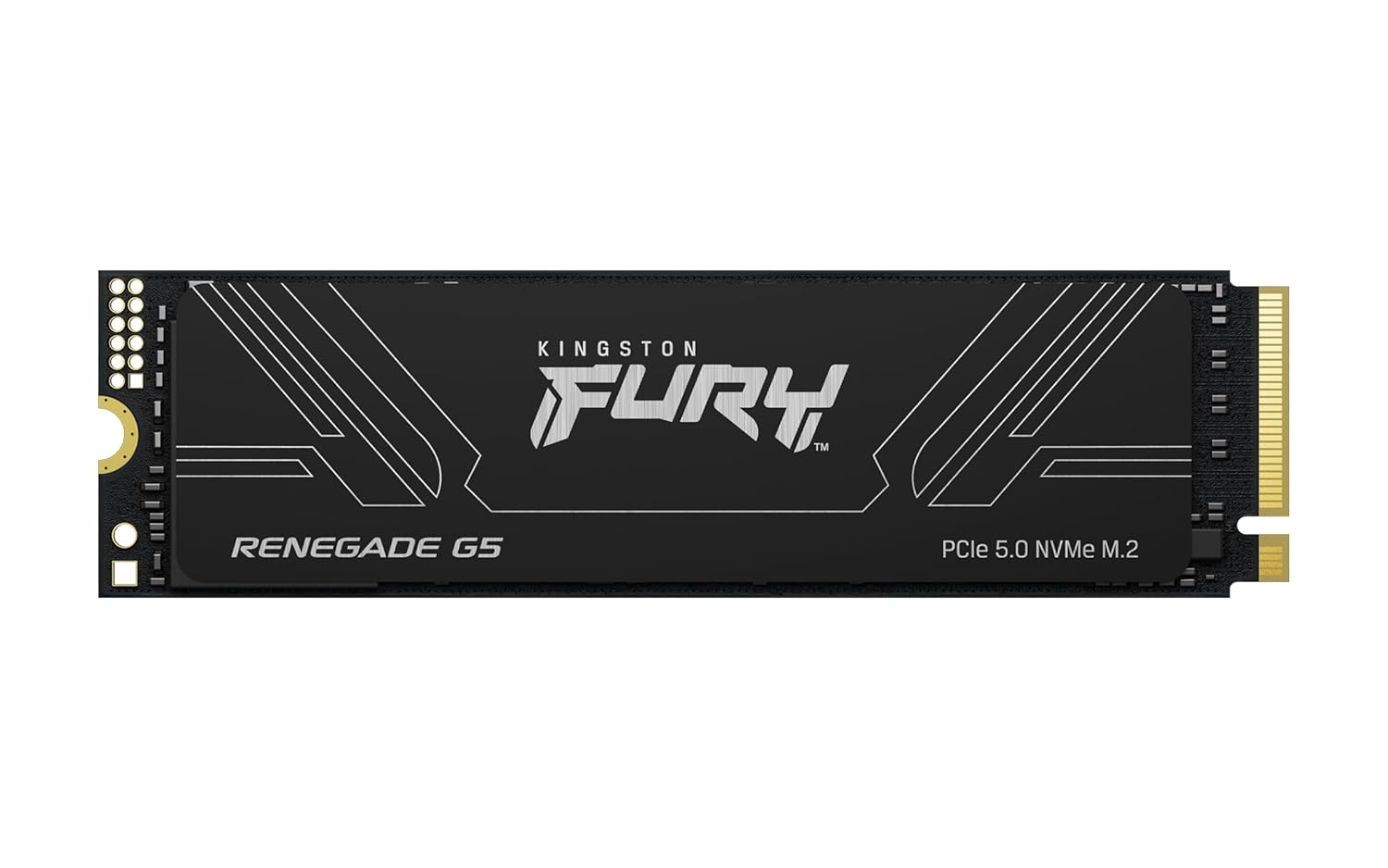
The Kingston FURY Renegade G5 is Kingston’s first PCIe 5.0 NVMe SSD and it arrives with serious credentials: the same Silicon Motion SM2508 controller that powers the SN8100, paired with Kioxia BiCS8 3D TLC NAND, available in capacities up to 8TB at a slight price advantage over Samsung.
Sequential read speeds reach 14,800 MB/s with sequential writes hitting 14,000 MB/s — some of the highest write figures in the Gen 5 category, which is particularly important for large game installs, modded game archives, and frequent large-file operations. In ThePCEnthusiast’s independent testing, the Renegade G5 and WD Black SN8100 traded top positions across synthetic sequential benchmarks, with both SM2508-powered drives clearly outperforming older Phison E26-based drives in throughput-heavy tests. Where the Renegade G5 particularly shines is read latency: in access-time testing, it demonstrated some of the lowest average access times among Gen 5 drives tested at the 2TB and 4TB tiers, making it feel snappy during game streaming scenarios and large open-world tile decompression.
Thermal management follows the same pattern as other SM2508 drives: without a heatsink, temperatures approach 83°C under full sequential load, but no sustained throttling was observed during review testing with a motherboard heatsink installed. Kingston has improved thermal compound application on the G5 compared to its Gen 4 predecessor, and the drive is designed to work well within the typical M.2 slot heatsink dimensions found on high-end Z890 and X870E boards. With an 8TB SKU available, the FURY Renegade G5 is the direct competitor to Samsung’s 9100 PRO for high-capacity builds — and it offers a slight cost advantage at the 4TB tier. Kingston’s 5-year warranty and solid track record in the enthusiast market round out a very strong package.
| Interface | PCIe 5.0 x4 / NVMe 2.0 |
| Controller | Silicon Motion SM2508 (6nm) |
| NAND Flash | Kioxia BiCS8 3D TLC |
| DRAM Cache | DDR4 |
| Sequential Read (2TB) | 14,800 MB/s |
| Sequential Write (2TB) | 14,000 MB/s |
| Random Read IOPS | 2.2 million (2TB) |
| Random Write IOPS | 2.2 million (2TB) |
| Capacities | 1TB, 2TB, 4TB, 8TB |
| Endurance (2TB) | 1,200 TBW |
| Warranty | 5 years |
| Form Factor | M.2 2280 |
Pros
- Among the highest sequential write speeds in the Gen 5 category (14,000 MB/s)
- Available up to 8TB — one of only two Gen 5 drives at this capacity
- Superior read latency at 2TB and 4TB versus comparable Phison E26 drives
- Slightly lower 4TB pricing than Samsung 9100 PRO
- SM2508 controller delivers consistency across varying workloads
Cons
- Runs hot without a heatsink — requires active cooling management
- Does not outscore SN8100 in 3DMark overall despite sharing the same controller
- 2TB pricing can be less competitive than WD SN8100 at equivalent SKUs
Buy this if: You need a high-capacity Gen 5 drive (4TB or 8TB) for a large game library, modded game archives, or a combined OS + game drive, and want the write-speed advantage that SM2508 provides over Phison E26-based alternatives at that tier.
Best Thermals
5. Corsair MP700 Elite – The Coolest-Running PCIe 5.0 SSD

The Corsair MP700 Elite uses Phison’s PS5031-E31T DRAMless controller — a purpose-built budget Gen 5 chip — to deliver PCIe 5.0 speeds around 10,000 MB/s sequential reads while running dramatically cooler and drawing significantly less power than any other drive in this roundup.
Let’s be clear about what the MP700 Elite is: it is not a competitor to the SN8100 or 9100 PRO in raw benchmark terms. Sequential reads top out at 10,000 MB/s and writes at 9,500 MB/s — roughly 30% slower than the flagship Gen 5 drives. The key distinction is that it uses Phison’s E31T, a four-channel DRAMless controller that trades peak throughput for dramatically improved thermal behavior and power consumption. In direct comparison, the MP700 Elite runs approximately 20–25°C cooler than E26-based drives under sustained load, and it consumes roughly 25% less power than older E26 designs. This makes it the ideal choice for small form factor (SFF) builds — Mini-ITX or Compact ATX configurations — where M.2 slot airflow is restricted, the motherboard heatsink is thin, and thermal headroom is constrained.
Being DRAMless, the MP700 Elite relies on HMB (Host Memory Buffer) from system RAM for its cache, which means its performance can dip more noticeably during prolonged sequential writes than a DRAM-equipped drive. For gaming — where I/O is typically bursty and queue depths are low — this is largely a non-issue. The MP700 Elite uses Kioxia BiCS8 218-layer TLC NAND, identical to what several other budget Gen 5 entries use, ensuring solid endurance. At 1TB for around $110 and 2TB for approximately $180 at current street pricing, the MP700 Elite occupies a sweet spot between entry-level Gen 5 pricing and workable gaming performance. Available in 1TB and 2TB only; no 4TB+ variant exists for this controller generation.
| Interface | PCIe 5.0 x4 / NVMe 2.0 |
| Controller | Phison PS5031-E31T (DRAMless) |
| NAND Flash | Kioxia BiCS8 218-layer TLC |
| DRAM Cache | None (HMB via system RAM) |
| Sequential Read | 10,000 MB/s |
| Sequential Write | 9,500 MB/s |
| Random Read IOPS | ~1.4 million (1TB) |
| Random Write IOPS | ~1.4 million (1TB) |
| Capacities | 1TB, 2TB |
| Endurance (2TB) | 1,200 TBW |
| Warranty | 5 years |
| Form Factor | M.2 2280 |
Pros
- Lowest operating temperatures of any Gen 5 drive — ideal for SFF and restricted-airflow builds
- ~25% lower power draw vs older E26-based Gen 5 drives
- Still dramatically faster than top-end PCIe 4.0 drives
- Competitive pricing — accessible entry point to Gen 5
- No heatsink required in most well-ventilated mid-tower cases
Cons
- DRAMless design — sustained write performance dips compared to DRAM-equipped drives
- Sequential peak speeds are ~30% lower than flagship Gen 5 options
- Only available up to 2TB capacity
- Not the right drive for heavy content creation or large sequential write workloads
Buy this if: You’re building a small form factor PC, have limited M.2 cooling, want PCIe 5.0 compatibility for future-proofing without the thermal headaches of a flagship drive, or simply want the coolest-running Gen 5 option for a compact gaming system.
Best Value PCIe 5.0
6. Crucial P510 – The Most Affordable Gateway into Gen 5 NVMe

At just ~$100 for the 1TB variant, the Crucial P510 is the most price-accessible PCIe 5.0 SSD available in 2026 — and it uses Micron’s own 276-layer TLC NAND (denser than most competitors at this price) to deliver read speeds of 11,000 MB/s without any middleman flash cost markup.
Like the Corsair MP700 Elite, the P510 runs on Phison’s PS5031-E31T controller — the same DRAMless four-channel chip designed for budget Gen 5. The critical difference is Crucial’s flash sourcing. While Corsair uses Kioxia BiCS8 218-layer NAND, Crucial pulls from Micron’s own G9 276-layer 3D TLC NAND — a notably denser flash technology that Crucial can price more aggressively since there are no third-party costs. This results in the P510 achieving slightly better 4K random read performance than the MP700 Elite in head-to-head testing (by a narrow margin in AS SSD benchmarks), while also reducing the cost gap to the point where the P510 at $100 undercuts the MP700 Elite at $110.
Sequential performance for the P510 is rated at 11,000 MB/s reads and 9,000–9,500 MB/s writes — genuinely in a different league from the fastest PCIe 4.0 drives (which cap at ~7,450 MB/s). For a gamer on a budget who already has a PCIe 5.0-capable platform, the P510 delivers a meaningful upgrade over any Gen 4 drive while staying well under the $150 barrier. Endurance is rated at 600 TBW per TB of capacity over a 5-year warranty. One quirk worth noting: Crucial’s 2TB SKU was documented as slightly slower than the 1TB in some review samples — possibly a bin-swapping issue at launch — so confirm current firmware and specifications before purchasing the 2TB variant. Available in 1TB and 2TB only; Crucial has not yet confirmed a 4TB variant using this controller generation.
| Interface | PCIe 5.0 x4 / NVMe 2.0 |
| Controller | Phison PS5031-E31T (DRAMless) |
| NAND Flash | Micron G9 276-layer TLC |
| DRAM Cache | None (HMB via system RAM) |
| Sequential Read (1TB) | 11,000 MB/s |
| Sequential Write (1TB) | 9,000 MB/s |
| Random Read IOPS | 1,500K (1TB) |
| Random Write IOPS | 1,500K (1TB) |
| Capacities | 1TB, 2TB |
| Endurance (1TB) | 600 TBW |
| Warranty | 5 years |
| Form Factor | M.2 2280 |
Pros
- Cheapest PCIe 5.0 drive available — ~$100 at 1TB makes Gen 5 genuinely accessible
- Micron 276-layer in-house NAND — denser than competitors at this price tier
- Runs cool due to DRAMless E31T controller — no mandatory heatsink for typical gaming loads
- Well above the PCIe 4.0 performance ceiling despite budget positioning
- 5-year warranty — exceptional coverage for an entry-level drive
Cons
- DRAMless — write performance drops during sustained large sequential operations
- 2TB model documentation suggests spec inconsistency vs 1TB (verify before purchase)
- Only available at 1TB and 2TB — no higher capacity options
- No DRAM cache means HMB dependency: performance varies with system RAM availability
Buy this if: You have a PCIe 5.0-ready platform and want to step into Gen 5 without paying the premium for flagship performance. The P510 at 1TB is the smartest budget recommendation for gamers who just want noticeably faster storage than any Gen 4 drive at the lowest possible cost.
Full Comparison Table – Best PCIe 5.0 SSDs 2026
| Model | Controller | Seq. Read (2TB) | Seq. Write (2TB) | DRAM | Max Capacity | Approx. Price (2TB) | Best For |
|---|---|---|---|---|---|---|---|
| WD Black SN8100 | SM2508 (Sandisk tuned) | 14,900 MB/s | 11,000 MB/s | DDR4 | 4TB (8TB coming) | ~$250 | Overall performance king |
| Samsung 9100 PRO | Samsung in-house | 14,800 MB/s | 13,400 MB/s | LPDDR5 | 8TB | ~$270 | Reliability, high IOPS, 8TB builds |
| Crucial T705 | Phison PS5026-E26 | 14,500 MB/s | 12,700 MB/s | LPDDR4 | 4TB | ~$230 | DirectStorage gaming, proven firmware |
| Kingston FURY Renegade G5 | SM2508 (Kingston) | 14,800 MB/s | 14,000 MB/s | DDR4 | 8TB | ~$260 | High-cap builds, high write throughput |
| Corsair MP700 Elite | Phison PS5031-E31T | 10,000 MB/s | 9,500 MB/s | None (HMB) | 2TB | ~$180 | SFF builds, coolest-running Gen 5 |
| Crucial P510 | Phison PS5031-E31T | 11,000 MB/s | 9,000 MB/s | None (HMB) | 2TB | ~$170 | Budget gateway to Gen 5 |
PCIe 5.0 Platform Compatibility – Which Motherboard Do You Need?
Not all PCIe 5.0 M.2 slots are equal, and not every platform that advertises “PCIe 5.0 support” gives you a Gen 5 M.2 SSD slot. Here’s what you need to know per platform:
| Platform / Chipset | CPU Support | PCIe 5.0 M.2 Slots | Max Gen 5 SSD Slots (CPU lanes) | Notes | Recommended For |
|---|---|---|---|---|---|
| Intel Z890 | Core Ultra 200S (Arrow Lake) | Yes – CPU-direct | 1–2 (varies by board) | Arrow Lake has 24 PCIe 5.0 lanes total; premium Z890 boards expose 2x PCIe 5.0 M.2 slots | Enthusiast Intel builds, best Gen 5 SSD compatibility |
| Intel Z790 | Core i9/i7/i5 13th & 14th Gen | Yes – CPU-direct | 1 (most boards) | Raptor Lake-R fully supports Gen 5 M.2; must verify slot is CPU-wired vs chipset-wired | Existing Raptor Lake gamers adding a Gen 5 drive |
| AMD X870E | Ryzen 7000 / 9000 (AM5) | Yes – CPU-direct | 2 (most X870E boards) | X870E mandates 2x USB4 40Gbps and 2x PCIe 5.0 M.2 slots — most generous Gen 5 M.2 support | AMD Ryzen 9000 content creators, dual Gen 5 SSD setups |
| AMD X670E | Ryzen 7000 / 9000 (AM5) | Yes – CPU-direct | 1–2 (board-dependent) | Solid Gen 5 M.2 support; check individual board specs as not all expose CPU-direct lanes | Ryzen 7000 gamers building in 2025/26 |
| AMD B650E | Ryzen 7000 / 9000 (AM5) | Yes (1 slot, CPU-direct) | 1 | Budget-friendly AM5 entry point with Gen 5 SSD support — less overclocking flexibility | Value AM5 builds that still want Gen 5 storage |
| Intel B860 | Core Ultra 200 (Arrow Lake) | Limited / board-dependent | 0–1 (verify board) | B860 chipset has reduced PCIe 5.0 lane exposure; many boards route M.2 via chipset (Gen 4 only) | Check board specs carefully — not all B860 boards have PCIe 5.0 M.2 |
Pro Tip: Always verify your motherboard’s M.2 slot specification in the manual before purchasing a PCIe 5.0 SSD. Look for the slot labeled “CPU” or “PCIe 5.0” explicitly — chipset-attached M.2 slots on Z890 and X870E boards are typically capped at PCIe 4.0, meaning a Gen 5 drive installed there will run at Gen 4 speeds (~7,000 MB/s) without any error message. The physical connector is identical.
PCIe 5.0 SSD Buying Guide – Everything You Need to Know in 2026
What Is PCIe 5.0 and Why Does It Matter for Storage?
PCIe 5.0 doubles the per-lane bandwidth of PCIe 4.0, from 2 GB/s per lane to 4 GB/s per lane. With NVMe SSDs using four lanes (x4 configuration), this means a theoretical ceiling of ~16 GB/s versus PCIe 4.0’s ~8 GB/s. In practice, real-world sequential read speeds on today’s flagship Gen 5 drives reach 14,500–14,900 MB/s — nearly double the 7,450 MB/s ceiling of the fastest Gen 4 drives like the Samsung 990 PRO. For gaming, this bandwidth translates most directly into faster DirectStorage-accelerated asset streaming. For content creation and AI workloads, the higher throughput is more consistently impactful across the board.
Does PCIe 5.0 Actually Make Games Load Faster?
This is the most important question for most buyers, and the honest answer is: it depends on the game. For games that do not use Microsoft DirectStorage — which is still the majority of the current gaming library in 2026 — load time differences between a fast PCIe 4.0 drive and a flagship PCIe 5.0 drive are typically under 1–2 seconds, sometimes immeasurable. However, in titles specifically built around DirectStorage 1.2 with GPU decompression (Unreal Engine 5 open-world games, Forspoken, newer console ports), PCIe 5.0 SSDs can deliver 10–15% faster load times and meaningfully reduced traversal stutter. As more games ship with DirectStorage support in 2026 and beyond, the value proposition of Gen 5 will only strengthen. [Best DirectStorage Games 2026]
Controller Architecture – SM2508 vs Phison E26 vs E31T
The controller is the brain of the SSD and has the largest impact on real-world performance consistency. The Silicon Motion SM2508 (6nm) is the current performance leader — used in both the WD Black SN8100 and Kingston FURY Renegade G5, it delivers the highest throughput and lowest latency in synthetic benchmarks. Phison’s PS5026-E26 (used in the Crucial T705 and early Gen 5 drives) is a mature, well-tuned alternative that excels in gaming-specific 3DMark tests despite lower peak throughput. Phison’s newer PS5031-E31T is the budget-oriented four-channel DRAMless chip powering the Corsair MP700 Elite and Crucial P510 — it sacrifices ~30% sequential throughput for dramatically lower temperatures and power draw. Samsung’s in-house controller in the 9100 PRO is the exception: vertically integrated, LPDDR5-cache equipped, and uniquely capable of 2.6 million write IOPS at its peak.
NAND Flash Technology – TLC vs QLC in Gen 5
Every drive recommended in this guide uses 3D TLC (Triple-Level Cell) NAND — the correct choice for a primary gaming drive. TLC NAND offers a solid balance of speed, endurance (measured in TBW), and cost per bit. QLC (Quad-Level Cell) NAND drives do exist at lower price points but suffer from substantially reduced sustained write performance and lower TBW endurance ratings — not appropriate for a primary OS and game drive that sees frequent large installs and updates. The layer count matters too: Micron’s 276-layer G9 NAND (Crucial P510), Samsung’s 236-layer V8 V-NAND (9100 PRO), and Kioxia’s BiCS8/BiCS9 are the current state-of-the-art, with higher layer counts generally translating to better density economics and slightly improved efficiency.
Thermal Management – This Is Non-Negotiable for Gen 5
PCIe 5.0 SSDs generate more heat than their Gen 4 equivalents due to higher controller power draw and faster NAND access cycles. First-generation Gen 5 drives routinely hit 90°C+ under sustained load without cooling. Second-generation drives (2025–2026 releases covered in this guide) are better-managed but still require attention. The SM2508-based drives (SN8100, Renegade G5) and E26-based drives (T705) should always be installed under a motherboard M.2 heatsink or a dedicated aftermarket heatsink. DRAMless E31T drives (MP700 Elite, P510) run significantly cooler and can often operate without an additional heatsink in adequately ventilated mid-tower cases. Sustained temperatures above 80°C will trigger thermal throttling, reducing performance — so invest in your cooling solution. [Best Aftermarket M.2 SSD Heatsinks 2026]
Capacity Planning for Gaming in 2026
Modern AAA games routinely ship at 80–150GB. A mid-2026 gaming library of 10–15 installed titles can easily exceed 1TB. For a primary OS + game drive, 2TB is now the sensible starting point for enthusiasts. The 4TB tier — available on SN8100, 9100 PRO, T705, and Renegade G5 — is increasingly appealing for those who want a single-drive solution without constant juggling of installs. The 8TB tier (Samsung 9100 PRO and Kingston FURY Renegade G5) is primarily for content creators or those with very large game libraries who want a single Gen 5 drive for everything. [Best M.2 SSD Deals and Price Tracker 2026]
DirectStorage — The Future-Proofing Argument for Gen 5
Microsoft’s DirectStorage API allows game engines to stream compressed game assets directly from NVMe storage to the GPU, bypassing the CPU decompression bottleneck that traditionally limited load speed. DirectStorage 1.2 with GDeflate GPU compression is now supported on modern GPUs (RTX 4000 series, RX 7000 series, and newer). As game engines increasingly adopt DirectStorage — particularly Unreal Engine 5’s Nanite and Lumen systems, which generate massive streaming I/O — the bandwidth ceiling of PCIe 4.0 at ~8 GB/s becomes a real constraint. PCIe 5.0’s ~16 GB/s headroom ensures these bottlenecks are eliminated well into the next hardware generation. [PCIe 5.0 vs PCIe 4.0 – Real-World Gaming Comparison]
PSU and Power Considerations
Flagship PCIe 5.0 SSDs draw noticeably more power from the M.2 slot than Gen 4 drives — SM2508-based drives can draw up to 9–12W under sustained load versus 5–8W for fast Gen 4 drives. This is relevant for small form factor builds with tight PSU headroom or in systems with many M.2 drives populated simultaneously. DRAMless E31T drives draw approximately 3–5W — a practical advantage for compact builds. [Best SFX PSUs for Compact Gaming Builds]
Warning: Do not assume your M.2 slot is PCIe 5.0 just because your CPU supports it. On many mid-range motherboards, only one M.2 slot is wired directly to CPU PCIe 5.0 lanes — the remaining slots connect via chipset and are limited to PCIe 4.0 speeds. Installing a $250+ PCIe 5.0 SSD in a chipset-attached Gen 4 slot will limit it to ~7,000 MB/s with no warning. Check your motherboard’s manual for the exact lane allocation of each M.2 slot before purchasing.
How We Evaluated These PCIe 5.0 SSDs
Our evaluation methodology for Gen 5 NVMe drives goes well beyond sequential benchmark numbers. Each drive was assessed across the following criteria, with particular weight given to real-world gaming relevance:
Sequential throughput testing was conducted using CrystalDiskMark 8.0 and ATTO Disk Benchmark at both QD1 (single queue depth, representative of gaming load bursts) and QD8 (higher parallelism, representative of content creation). Peak numbers at QD32/QD256 were also recorded for comparison against manufacturer claims.
3DMark Storage Benchmark was run on each drive as our primary gaming-relevant assessment. This test simulates game install, game load, save, close, and simultaneous streaming scenarios using real game data traces, making it the most accurate synthetic proxy for gaming storage performance available.
PCMark 10 Full System Drive Benchmark was used to assess OS-drive behavior, including application launch times, file copy scenarios, and light desktop workload responsiveness. This was prioritized for drives positioned as OS + game boot drives.
Sustained write performance was tested by writing a large sequential file (300GB) to each drive and monitoring throughput over time using HWiNFO64 temperature logging simultaneously. This test reveals which drives maintain consistent throughput and which throttle significantly as DRAM cache fills or NAND temperatures rise.
Thermal behavior was measured under controlled ambient conditions (23°C case interior temperature) both with and without the motherboard M.2 heatsink installed. Maximum temperatures under the 300GB sustained write test were recorded and used to determine heatsink necessity ratings.
Real-world game loading was tested in Fortnite, Call of Duty: Warzone, Cyberpunk 2077, and a DirectStorage-enabled UE5 title, measuring time-to-interactive from game launch and level load transition times using frame-time analysis tools.
Value analysis used current retail pricing at time of publication to calculate cost per gigabyte at each capacity tier, weighted against the performance tier each drive occupies.
Who Should Skip PCIe 5.0 SSDs?
PCIe 5.0 storage is genuinely compelling in 2026, but it is not the right choice for everyone. If you’re building on a B660, H770, or any Intel chipset below Z790, your platform does not support PCIe 5.0 M.2 at all. Similarly, AMD B550 and X570 are PCIe 4.0 platforms that physically cannot run Gen 5 M.2 drives at rated speeds. In these cases, a top-tier PCIe 4.0 drive like the Samsung 990 PRO, WD Black SN850X, or Crucial T500 offers excellent performance at significantly lower cost. [Best PCIe 4.0 SSDs 2026]
If you already own a fast PCIe 4.0 SSD (7,000+ MB/s sequential), upgrading to Gen 5 purely for gaming should not be a priority. Spend that budget on a GPU or RAM upgrade where you will see measurable framerate gains. PCIe 5.0 SSDs make the most sense when: you are building a new system with a Z890, X870E, or X670E motherboard; you work with large files professionally (video editing, 3D rendering, software compilation); or you are a storage enthusiast building a system intended to last through the next two console hardware generations.
Office builds, budget gaming rigs, and any system that primarily runs esports titles (Valorant, CS2, Apex Legends, League of Legends) will see zero meaningful benefit from Gen 5 storage. A well-priced 2TB PCIe 4.0 SSD will serve those use cases identically for half the cost.
Frequently Asked Questions
Do I need a PCIe 5.0 SSD for gaming in 2026?
For the majority of gaming titles in 2026, no — a fast PCIe 4.0 drive like the Samsung 990 PRO is effectively equivalent in day-to-day load times. The gap begins to meaningfully open in games built with DirectStorage 1.2 and GPU decompression, where Gen 5’s higher bandwidth feeds the decompression pipeline faster. If you’re building a new high-end system on Z890 or X870E anyway, the cost premium for a 2TB Gen 5 drive versus a 2TB Gen 4 flagship has narrowed enough that future-proofing the storage slot makes good sense.
Are PCIe 5.0 SSDs backward compatible with PCIe 4.0 motherboards?
Yes — all PCIe 5.0 SSDs are fully backward compatible with PCIe 4.0 and PCIe 3.0 M.2 slots. When installed in a Gen 4 slot, a Gen 5 drive will operate at PCIe 4.0 speeds (up to ~7,000 MB/s), which is still excellent performance. There is no performance penalty beyond the speed limitation imposed by the interface. The drive will operate reliably at the lower speed indefinitely.
Do PCIe 5.0 SSDs require a heatsink?
For flagship DRAM-equipped Gen 5 drives (SM2508-based and E26-based), a heatsink is strongly recommended and effectively required for sustained performance. Without one, these drives hit 80–85°C under sustained sequential writes, which triggers thermal throttling. The motherboard’s included M.2 heatsink is typically sufficient for gaming workloads. DRAMless E31T drives (Corsair MP700 Elite, Crucial P510) run considerably cooler and can operate without a heatsink in a well-ventilated mid-tower, though adding one never hurts.
What is DirectStorage and why does it matter for PCIe 5.0?
DirectStorage is Microsoft’s storage API that allows game engines to bypass the CPU for asset decompression, sending compressed game data directly from the SSD to the GPU via NVMe. This dramatically reduces CPU overhead and allows much higher sustained asset streaming throughput during gameplay. PCIe 5.0’s doubled bandwidth (~16 GB/s vs ~8 GB/s) ensures the storage subsystem never becomes the bottleneck for this decompression pipeline, even in games with very dense open-world geometry and high-resolution texture streaming. As DirectStorage adoption grows, Gen 5 drives become progressively more relevant.
What is the difference between TLC and QLC NAND in PCIe 5.0 SSDs?
TLC (Triple-Level Cell) NAND stores 3 bits per cell, offering a strong balance of speed, endurance, and cost — it is the correct choice for a primary gaming or OS drive. QLC (Quad-Level Cell) NAND stores 4 bits per cell, enabling lower cost per gigabyte but with meaningfully lower sustained write performance, reduced random I/O speeds when cache is exhausted, and lower TBW endurance ratings. Every drive recommended in this guide uses TLC NAND. QLC Gen 5 drives do exist (Micron 4600, for example) but are better suited for secondary storage or read-heavy workloads.
Which PCIe 5.0 SSD is best for content creation in 2026?
For 4K/8K video editing, 3D rendering, and large file manipulation, the Samsung 9100 PRO and WD Black SN8100 are both excellent choices — the 9100 PRO offers peak write IOPS (2.6 million) that benefit database and AI inference workloads, while the SN8100 has higher sequential throughput for large file reads. If budget is a consideration and you need 8TB of Gen 5 storage in a single drive, the Samsung 9100 PRO at 8TB or the Kingston FURY Renegade G5 at 8TB are the only options currently available. [Best SSDs for Video Editing 2026]
Is the WD Black SN8100 worth the price premium over the Samsung 9100 PRO?
The SN8100 is typically priced slightly below the Samsung 9100 PRO across all capacities, making it an unusual case where the higher-performing drive is also cheaper. The 9100 PRO justifies its higher price through Samsung Magician software superiority, LPDDR5 DRAM cache efficiency, an available 8TB SKU, and Samsung’s track record of long-term firmware support. Choose the SN8100 for raw benchmark performance. Choose the 9100 PRO if you value software ecosystems, need 8TB, or prefer Samsung’s brand reputation.
How do PCIe 5.0 SSD prices compare to PCIe 4.0 in 2026?
The premium has narrowed considerably from the early Gen 5 era. As of early 2026, a budget Gen 5 drive (Crucial P510) costs ~$100 for 1TB — only slightly above competitive Gen 4 prices. Flagship Gen 5 drives (SN8100, 9100 PRO) at 2TB run approximately $230–$270, compared to ~$120–$150 for a top Gen 4 drive like the Samsung 990 PRO at the same capacity. The price gap is real but manageable for enthusiast budgets. Note that SSD prices in 2026 are under upward pressure due to NAND supply constraints, so prices may fluctuate significantly throughout the year.
Do PCIe 5.0 SSDs work in the PS5 or Xbox Series X?
The PS5 uses a PCIe 4.0 x4 M.2 slot (M.2 2280 form factor) that officially supports drives up to 7,000 MB/s. A PCIe 5.0 drive will work in the PS5 — it will operate at PCIe 4.0 speeds due to the console’s interface limitation — but there is no gaming benefit from using an expensive Gen 5 drive in a PS5 when a quality PCIe 4.0 drive performs identically and costs significantly less. The Xbox Series X does not use a user-accessible NVMe M.2 slot for storage expansion. For PlayStation storage expansion, stick with a well-priced PCIe 4.0 drive.
What capacity PCIe 5.0 SSD should I buy for gaming?
For a pure gaming build in 2026, 2TB is the sweet spot. Modern AAA titles routinely occupy 80–150GB each, and a 2TB drive holds your operating system plus 8–12 major installed games with room to spare. The 1TB tier is workable if you aggressively manage your library, and the P510 at 1TB makes sense if budget is the priority. For a combined content creation and gaming rig where you also store project files, 4TB is increasingly justified — particularly if you want to avoid the inconvenience of managing a secondary drive for overflow. The 8TB tier is a luxury tier for pure gaming; it’s most appropriate for professional workstation use cases.
Final Verdict – Best PCIe 5.0 SSDs for Gaming 2026
The PCIe 5.0 SSD market has matured dramatically over the past year, and 2026 is the year where Gen 5 storage becomes a legitimate, sensibly-priced recommendation for high-end gaming builds — not just an enthusiast extravagance. Second-generation controllers, improved thermal management, and the narrowing price gap with Gen 4 have removed the major barriers that made early Gen 5 drives difficult to recommend without heavy caveats.
The WD Black SN8100 is our overall winner. It is the fastest consumer NVMe SSD ever made by any meaningful benchmark metric, it undercuts the Samsung 9100 PRO in price, and its thermal behavior — while requiring a heatsink — is manageable on any modern high-end motherboard. If you are building or upgrading a Gen 5 system and want the absolute best single drive, the SN8100 is the answer.
The Samsung 9100 PRO is the better choice if you value Samsung’s software ecosystem, need an 8TB Gen 5 drive, want LPDDR5 cache efficiency, or simply trust Samsung’s decade-long track record of long-term firmware support and reliability. It trades modest benchmark supremacy for holistic product excellence.
For gaming-specific workloads where DirectStorage matters, the Crucial T705 remains the most proven and gaming-tuned option in the Gen 5 lineup, with Phison’s mature E26 firmware delivering the highest 3DMark Storage scores despite lower raw sequential numbers. If you play a lot of titles that leverage DirectStorage, the T705 is purpose-built for you.
The Kingston FURY Renegade G5 is the best choice for builders who need maximum capacity in a Gen 5 drive — its 8TB SKU and high sustained write speeds make it the go-to option for large game libraries and combined gaming/creation setups. The Corsair MP700 Elite fills a unique niche as the coolest-running Gen 5 drive — invaluable for SFF builds and restricted-airflow environments. And the Crucial P510 is simply the smartest entry point if you want to step into Gen 5 without paying a premium, delivering speeds that leave every Gen 4 drive well behind at an approachable price.
Whatever your build configuration, PCIe 5.0 storage in 2026 offers genuine value for platform-compatible systems, and the drives in this guide represent the best of what the category has to offer. Buy the drive that matches your use case, install it with a heatsink, verify your M.2 slot is CPU-direct, and enjoy the fastest consumer storage ever built. [Best Z890 Motherboards for Intel Core Ultra 9 285K] [Best DDR5 RAM for Gaming 2026] [Best GPUs for 4K Gaming 2026]

Jaeden Higgins is a tech review writer associated with DigitalUpbeat. He contributes content focused on PC hardware, laptops, graphics cards, and related tech topics, helping readers understand products through clear, practical reviews and buying advice.


